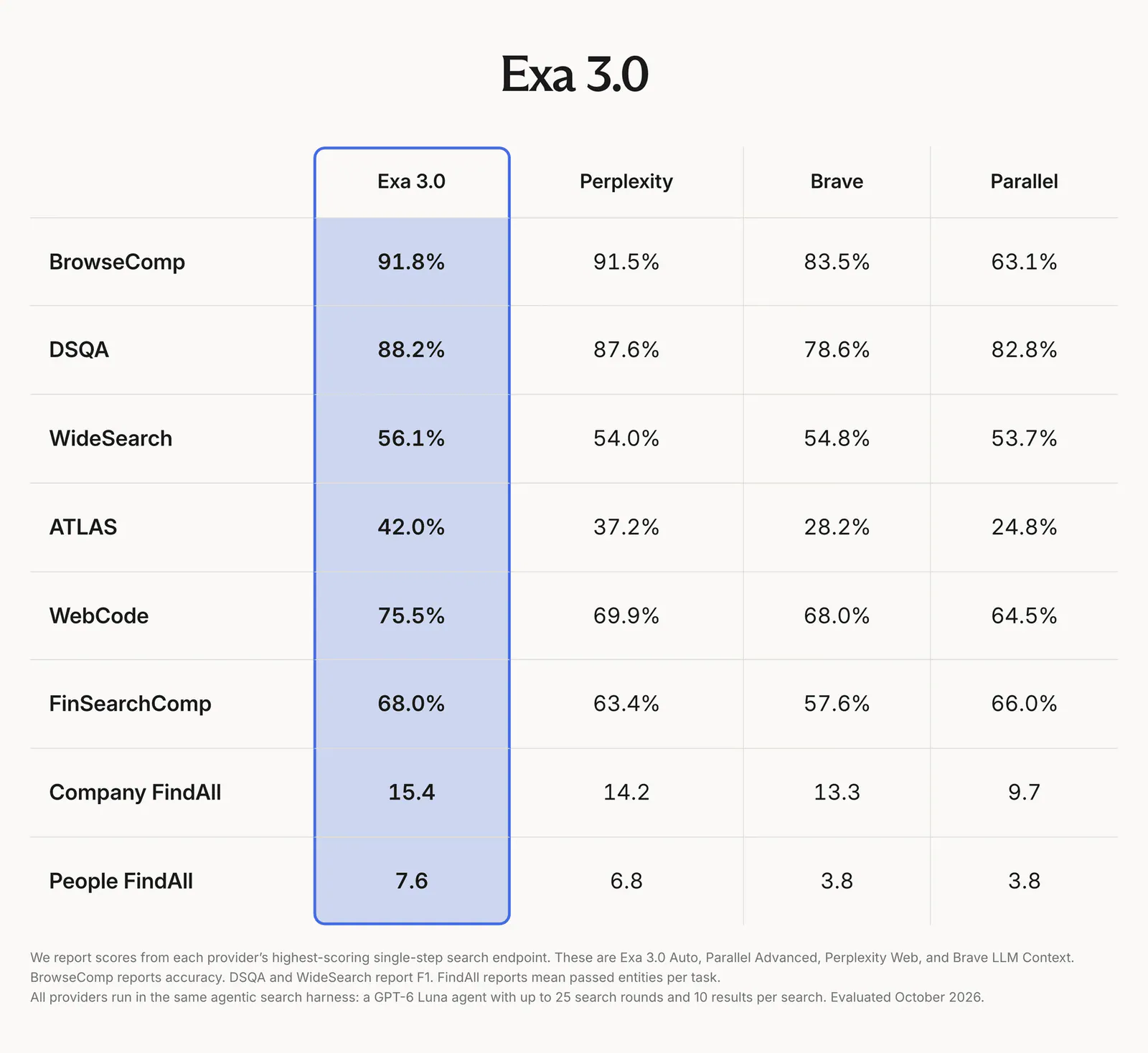
Exa’s new Lite search tier costs $4 per 1,000 requests, compared with $7 for Auto. Developers building agents that repeatedly search the web can spend less per retrieval or pay for the additional computation Exa applies in Auto.
The Exa 3.0 announcement, published October 19, 2026, also makes Dynamic Highlights generally available and expands the company’s independent index. Exa says the upgraded highlights use 95% fewer tokens than full-page text, while the index adds broader coverage of shopping, local businesses, and real-time information.
These changes address different parts of an agent’s budget. Lite lowers the search API charge; highlights reduce the retrieved material passed to a language model. Neither, by itself, establishes that an agent will produce an equally good answer. Developers need to evaluate retrieval quality and content depth separately.
Lite Cuts the Base Search Price by About 43%
Lite and Auto use the same index, according to Exa. Auto applies more computation across candidate generation, highlights, and ranking. Exa positions it as the higher-quality option, while Lite targets cost-sensitive applications.
The API pricing documentation gives the following base rates:
| Search type | Price per 1,000 requests | Results included per request |
|---|---|---|
| Lite | $4 | Up to 10 |
| Auto | $7 | Up to 10 |
Lite’s base price is approximately 43% lower. At one million requests, the listed rates translate to $4,000 for Lite versus $7,000 for Auto, before additional results or other billable operations. That is a $3,000 difference in the search bill alone.
Each result above the first 10 adds $1 per 1,000 additional results. A developer asking for 20 results per request therefore pays for 10 extra results each time. Twice the material is not included at the headline price.
These prices cover individual requests. An agent that reformulates a query several times or searches repeatedly while answering one question will accumulate multiple charges for that research task.
Lite is attractive for high-volume discovery, but the relevant comparison is cost per satisfactory answer. If cheaper retrieval causes enough retries, the initial saving can shrink. If Lite finds the necessary evidence on the first attempt, paying for Auto may add cost without improving the application’s result.