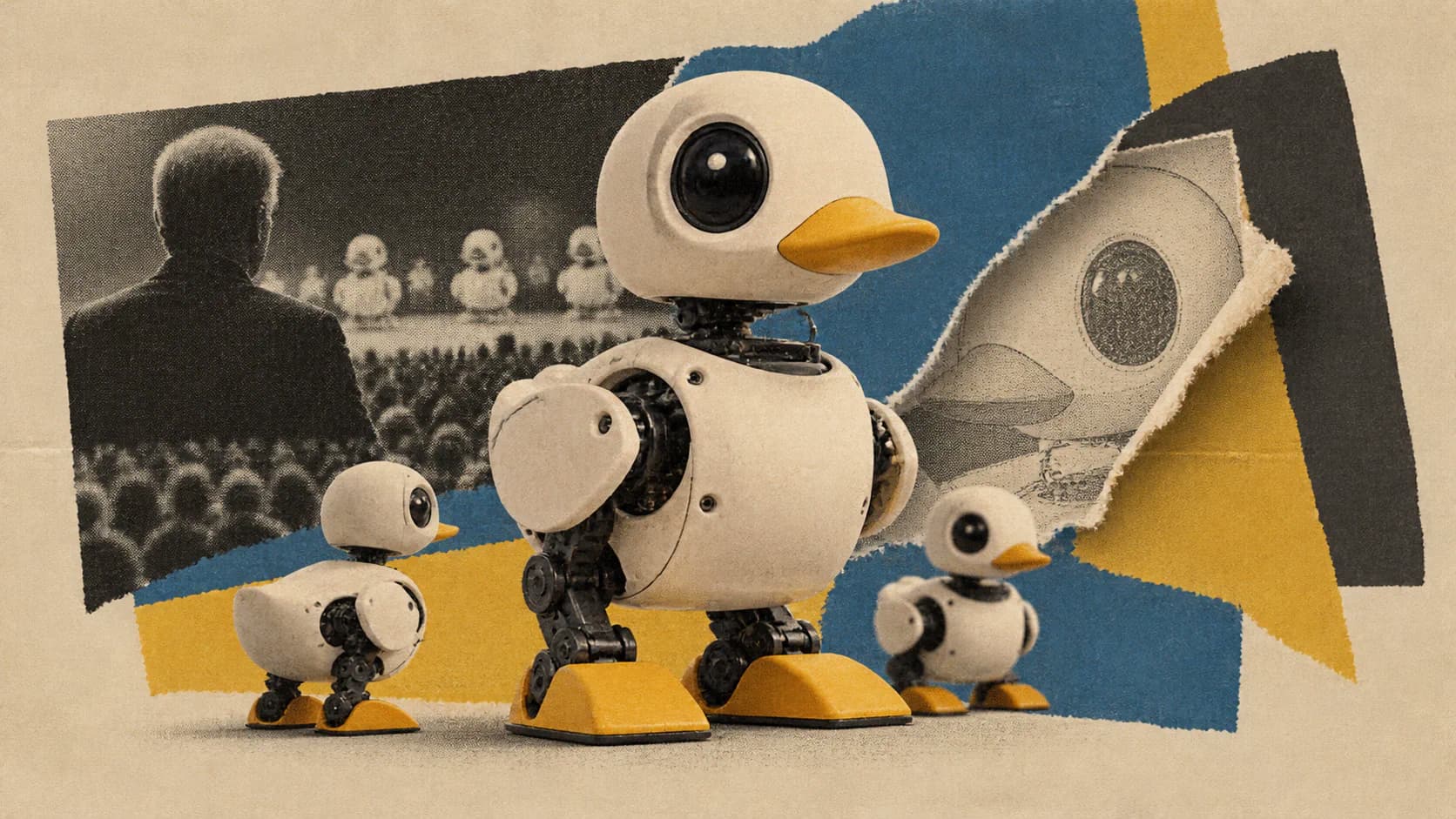
Hugging Face’s Microduck has passed 20,000 preorders following Nvidia CEO Jensen Huang’s demonstration at GTC Berlin, according to Hugging Face cofounder Clément Delangue. The duck-shaped robot, made by Hugging Face’s Pollen Robotics arm, carries a reported introductory price of $399 before taxes and shipping.
TechCrunch’s October 23, 2026 report places the milestone the day after the demonstration drew attention online. This is a commercialization story about an existing robot, not a new product launch.
The distinction matters: 20,000 preorders are a company-reported demand signal, not 20,000 delivered robots. The figure has not been independently audited, and the available reporting does not establish payment status, cancellation rates or production capacity. Even with those limits, the claimed order volume gives Hugging Face’s robotics push a visible commercial signal beyond a popular stage appearance.
Huang’s Demo Made Robot Movement Easy to Understand
Huang appeared with a group of Microducks that waddled, made electronic chirping sounds, sat, flopped over for a nap and performed somersaults on command, according to TechCrunch. Delangue attributed the subsequent preorder surge to that showcase.
The demonstration gave prospective buyers something more concrete than an embodied-AI pitch. A small robot moving, responding and recovering is an understandable product proposition, even for someone who has never trained a model or written robotics software.
My view is that this helps explain the appeal: Microduck presents robot learning through visible, low-stakes actions. A somersault communicates immediately; a description of a simulation pipeline needs explanation. The preorder claim suggests that presentation resonated, although the available evidence cannot separate Huang’s influence from the price, design or wider publicity.
A stage routine also has a narrow evidentiary scope. It shows the actions performed under demonstration conditions. It gives buyers no measured success rate across different floors, obstacles or home environments.
What the $399 Price Gets You
Martin Cid Magazine’s October 24 report describes a compact motorized robot with onboard sensing and preset behaviors.
| Detail | Reported specification or condition |
|---|---|
| Introductory price | $399, excluding taxes and shipping |
| Height | Approximately 25 centimeters |
| Weight | Approximately 800 grams |
| Movement hardware | 15 motors |
| Vision and sensing | Camera, small depth sensor and two motion sensors |
| Sound | Speaker |
| Basic control | Gamepad operation, with no coding required for preset use |
| Delivery target | Before Christmas 2026 |
These are reported specifications, not measurements from an independent hardware test. The introductory label also leaves open whether later buyers will pay the same price.
The hardware supports a more specific purchase proposition than “AI robot.” Motors provide movement, while the camera and other sensors provide inputs software can use. Their presence alone says little about navigation quality, obstacle handling or what information is processed locally.
Martin Cid also reports that Microduck can carry small objects in its beak, get up after falling and roller-skate after its feet are exchanged for wheels. Those are reported capabilities; the coverage does not provide a complete retail box inventory, so buyers should check which accessories accompany the advertised price.
Gamepad operation and Huang’s voice-command demonstration deserve separate treatment. The former is described as a way to use the robot without programming. The latter shows a command interface in a keynote setting. It leaves unanswered whether voice processing requires an external computer, an internet connection or a particular software setup.
Preset Tricks and Robot Training Are Different Jobs
TechCrunch reports that Microduck’s basic movements were trained in simulation using Nvidia’s technology stack. Pollen says owners will be able to train additional tricks and share them with the community.
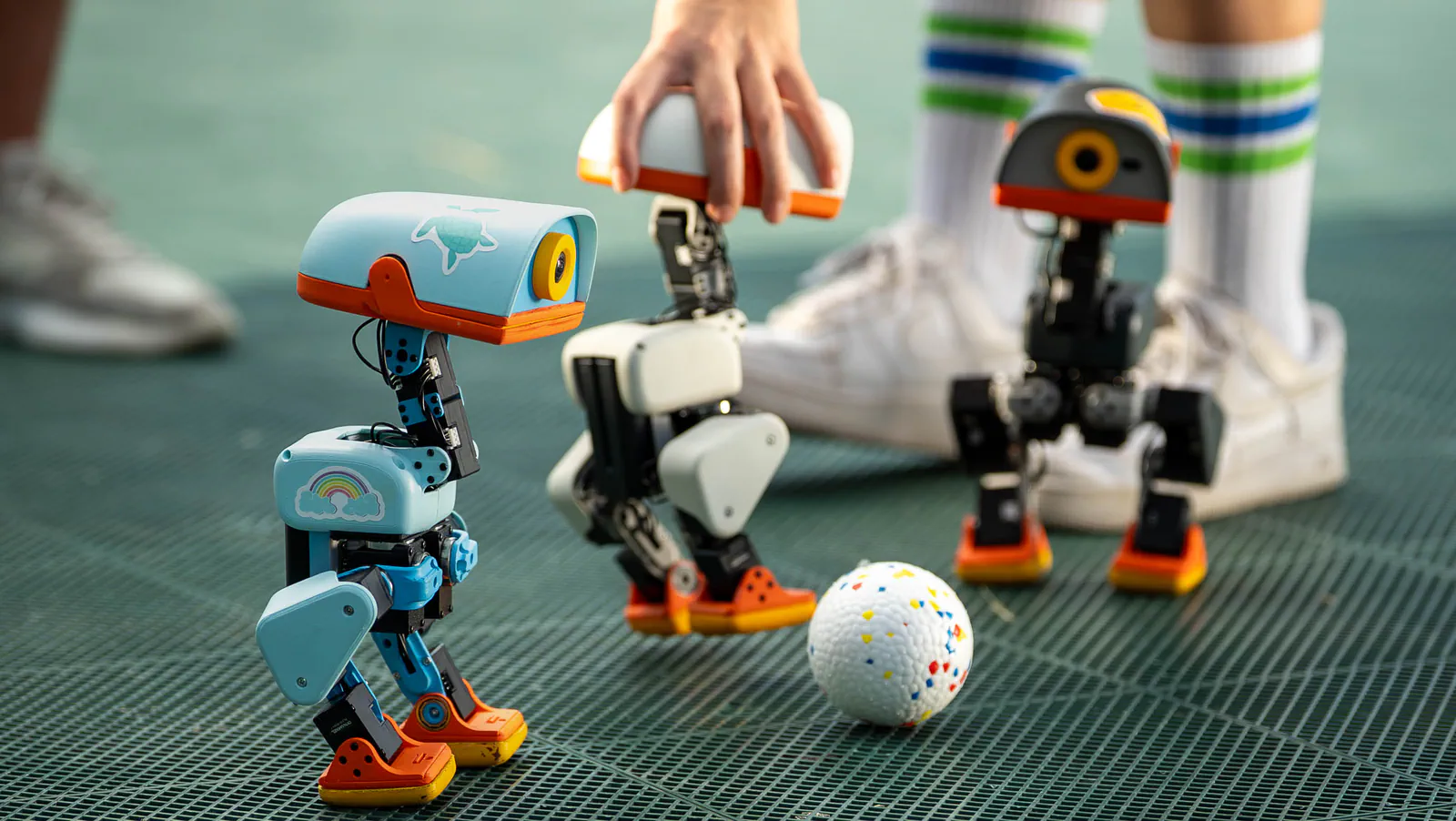
The basic workflow is to develop movement behavior in a simulated version of the robot, then transfer the learned behavior to the physical machine. That separates the training process from everyday operation: a buyer using an existing walking behavior is doing something different from a developer teaching a new movement.
Three layers are worth keeping distinct:
- Demonstrated behavior: The movements shown during Huang’s appearance, including sitting and somersaulting.
- Reported included behavior: The basic movements the company says Microduck ships with.
- Developer extensibility: The tools and work involved in training, transferring and sharing additional behaviors.
This distinction is consequential for anyone treating Microduck as an inexpensive embodied-AI platform. Ready-made movements can make the hardware accessible immediately. Developing reliable new ones introduces questions about simulation setup, training resources and physical testing.
Nvidia’s involvement in the training story should not be read as a complete shopping list. The reporting does not establish which computer or GPU a home developer needs, how long training takes, or whether particular tasks require paid services.
I’d put reliable walking and getting back up ahead of a growing trick list when judging the platform’s usefulness. Those behaviors provide the foundation for further experiments; an impressive routine is less useful if a developer cannot build on it consistently.
Open Software Is the Longer-Term Proposition
Martin Cid reports that Pollen has published a software kit, simulator and reinforcement-learning stack on GitHub under the Apache 2.0 license. TechCrunch separately reports the company’s promise that users can train and share new tricks.
Frequently Asked Questions
3 questions
1How much does Microduck cost?
The reported introductory price is $399 before taxes and shipping. Included accessories and the final regional price should be checked before ordering.