
Google released Gemini 3.8 Flash and Gemini 3.8 Flash Cyber on September 2, 2026. The general-purpose model focuses on software engineering, autonomous agents, and multi-step professional work, while the Cyber variant targets vulnerability discovery and automated patching.
This is Google’s third major Gemini Flash release since July 21. More importantly, Gemini 3.8 Flash reaches roughly 74% on DeepSWE v1.1, putting the relatively inexpensive AI model alongside substantially costlier frontier systems on long-horizon coding.
That headline needs context. Gemini 3.8 Flash does not beat every larger LLM, and some of its improvements come from spending more tokens and taking more agent steps. The release is still technically significant because its cost per completed engineering task remains competitive even when the model “works harder.”
Three Flash Releases in 43 Days
Google launched Gemini 3.6 Flash on July 21, followed by Gemini 3.7 Flash on August 13 and Gemini 3.8 Flash on September 2. That is three releases in 43 days, which Google describes as six weeks.
Each release has moved the Flash family further into work previously associated with larger, more expensive models:
- Gemini 3.6 Flash improved token efficiency, coding, multimodal performance, and knowledge work.
- Gemini 3.7 Flash made a larger jump in software engineering, web development, and multi-step tool use.
- Gemini 3.8 Flash concentrates on long-running coding agents, specialized professional workflows, and more persistent reasoning.
Google’s model card says Gemini 3.8 Flash is based on 3.7 Flash. The company credits the latest gains to long-running agentic loops that recursively evaluate and refine models, combined with training in demanding cybersecurity tasks. Google has not disclosed enough architectural detail to determine how much of the improvement comes from new training data, post-training methods, or additional inference-time computation.
The pace suggests Google is treating Flash as a rapidly updated production line rather than waiting for major Gemini generation changes. That can deliver improvements faster, but it also gives developers less time to evaluate behavior changes between releases.
DeepSWE Is the Headline, but the Benchmark Needs Context
DeepSWE v1.1 evaluates coding agents on 113 original, long-horizon engineering tasks. The tasks cover 91 repositories and five programming languages, with manually written verifiers that test software behavior rather than requiring one predetermined implementation. All models use the same mini-swe-agent harness.
On the live leaderboard, Gemini 3.8 Flash at high effort records:
- 74% ±1% pass rate
- $2.36 average cost per task
- 143,000 output tokens
- 166 agent steps
Claude Opus 5 also displays a rounded score of 74%, with a wider ±4% interval and an average cost of $11.84 per task. GPT-5.6 Sol follows at 73% and $6.46 per task. Gemini 3.7 Flash scores 65% at an average cost of $2.18.
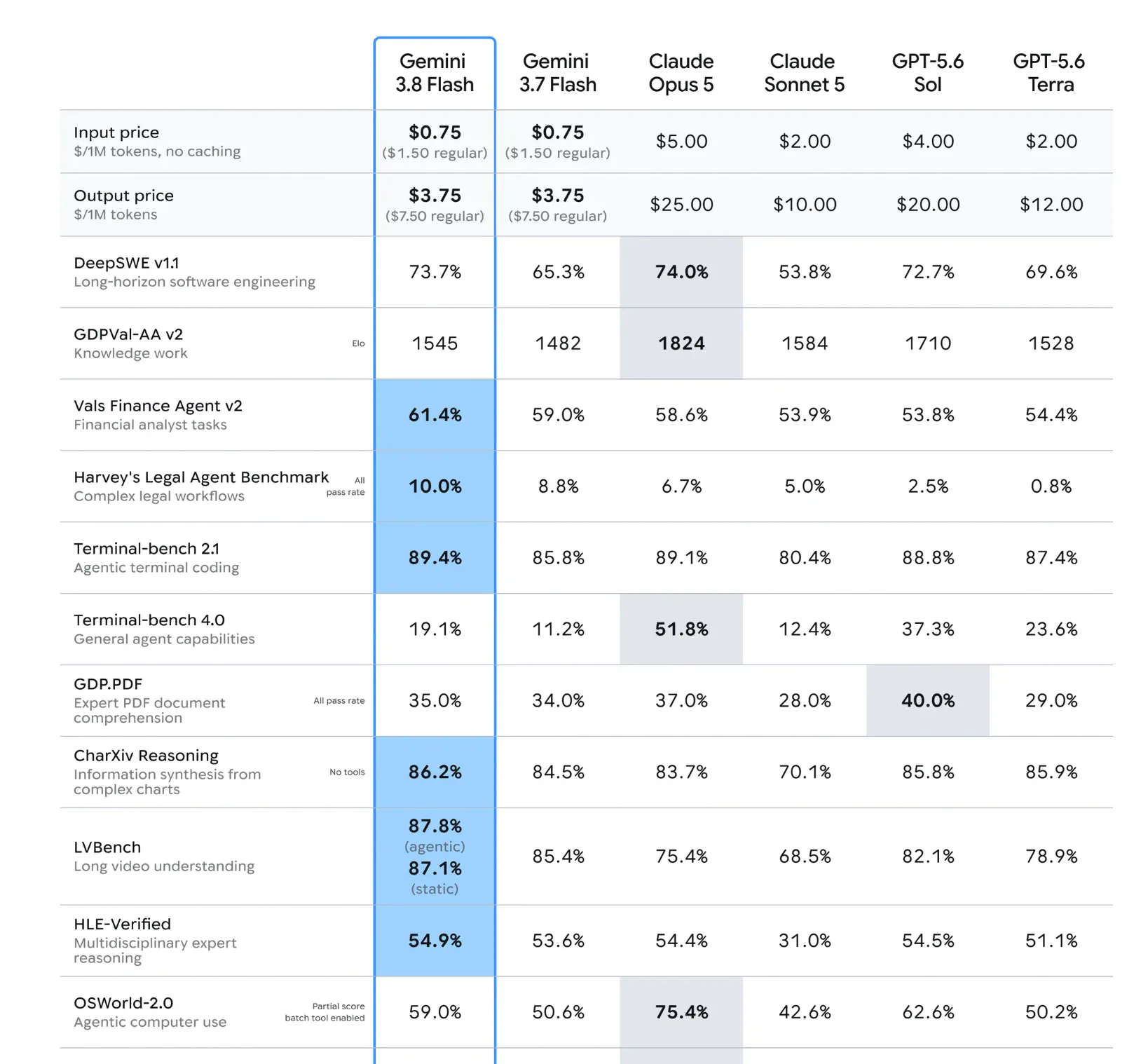
Google’s evaluation table reports the unrounded Gemini result as 73.7%, compared with 74.0% for Claude Opus 5 and 72.7% for GPT-5.6 Sol. Google can reasonably say Gemini 3.8 Flash outperforms most larger frontier models on this evaluation, but the published figures do not establish a clear lead over Opus 5.
The cost result is more decisive. Gemini completes DeepSWE tasks at about one-fifth the average cost of Opus 5 in the live benchmark. It also comes close to Opus despite having standard output pricing of $3.75 per million tokens during Google’s introductory pricing period, compared with the $25 figure used for Opus in Google’s evaluation table.
The comparison with Gemini 3.7 Flash reveals how Google produced the improvement. The new model uses roughly 34% more output tokens and takes 33% more agent steps, while average DeepSWE task cost rises by approximately 8%. In exchange, its rounded pass rate increases from 65% to 74%.
Gemini 3.8 Flash is therefore not simply generating the same work more efficiently. It is allocating more reasoning and tool use to difficult problems, while its low token price keeps the resulting task-level cost manageable.
The Gains Extend Beyond Coding
Google’s broader evaluation table shows improvements in finance, law, terminal-based coding, chart interpretation, long-video understanding, biology research, and expert reasoning. Several results place Gemini 3.8 Flash slightly ahead of far more expensive models. Others expose a substantial remaining gap.
| Evaluation | Gemini 3.8 Flash | Gemini 3.7 Flash | Best Named Rival |
|---|---|---|---|
| DeepSWE v1.1 | 73.7% | 65.3% | Claude Opus 5: 74.0% |
| Vals Finance Agent v2 | 61.4% | 59.0% | Claude Opus 5: 58.6% |
| Harvey’s Legal Agent Benchmark | 10.0% | 8.8% | Claude Opus 5: 6.7% |
| Terminal-bench 2.1 | 89.4% | 85.8% | Claude Opus 5: 89.1% |
| HLE-Verified | 54.9% | 53.6% | GPT-5.6 Sol: 54.5% |
| Terminal-bench 4.0 | 19.1% | 11.2% | Claude Opus 5: 51.8% |
| OSWorld-2.0 | 59.0% | 50.6% | Claude Opus 5: 75.4% |
The finance result is a 2.4 percentage-point improvement over 3.7 Flash. Gemini 3.8 also leads Google’s comparison group on the legal benchmark, Terminal-bench 2.1, HLE-Verified, and CharXiv without tools. These are Google-reported evaluations, so they should be treated as release evidence rather than independent confirmation.
The small HLE-Verified margin is particularly easy to overstate. Gemini 3.8 Flash scores 54.9%, while GPT-5.6 Sol and Claude Opus 5 reach 54.5% and 54.4%. That places Flash in the same performance band, but differences of less than one percentage point rarely justify sweeping claims about general intelligence.
The weaker results matter just as much. Claude Opus 5 scores 51.8% on Terminal-bench 4.0, compared with Gemini’s 19.1%, and reaches 75.4% on OSWorld-2.0 against Gemini’s 59.0%. Opus also holds a large lead in Google’s GDPVal-AA v2 knowledge-work evaluation.
Gemini 3.8 Flash is highly competitive when a task rewards persistent coding, tool iteration, structured analysis, or specialized reasoning. It is not a universal replacement for larger frontier models across general computer use and open-ended autonomous work.
More Reasoning Improves Quality but Can Raise Cost
Google explicitly says Gemini 3.8 Flash “works harder” on complex requests. It can execute additional reasoning steps, call tools repeatedly, and continue iterating when an initial approach fails. That behavior is useful for software agents, where stopping early with an incomplete patch is often worse than consuming more tokens.
Developers can control this behavior with low, medium, and high thinking levels. The minimal setting is not supported. High effort is likely to be the relevant configuration for demanding coding benchmarks, while lower settings should suit routine extraction, classification, and straightforward tool use.
This changes how teams should evaluate the AI model. Price per million tokens is only one part of the calculation. A production test should also measure:
- Completion rate without human intervention
- Total input, output, and reasoning tokens
- Number of tool calls and agent steps
- Wall-clock latency
- Retry frequency
- Cost per accepted task
- Quality of generated patches or artifacts
A model that charges less per token can still become expensive if it loops unnecessarily. Conversely, a longer run can be cheaper than repeated failed attempts with a less capable model.
Google’s model card warns that Gemini 3.8 Flash can occasionally experience slowness or timeouts and may consume more tokens at higher effort settings. The company says 3.7 Flash will remain supported for applications where compute efficiency matters more than maximum task performance.
What Developers Get at Launch
The Gemini 3.8 Flash API documentation lists gemini-3.8-flash as a stable, generally available model rather than a preview release. Its main specifications are:
- Input context: 1,048,576 tokens
- Maximum output: 65,536 tokens
- Inputs: Text, images, video, audio, and PDFs
- Output: Text
- Thinking levels: Low, medium, and high
- Tools: Function calling, code execution, file search, URL context, Google Search grounding, and Google Maps grounding
- Computer use: Supported in preview
- Structured output: Supported
- Context caching: Supported
- Live API: Not supported
- Image and audio generation: Not supported
Gemini 3.8 Flash is available through Google AI Studio, the Gemini API, Google Antigravity, Gemini Enterprise, and consumer products including the Gemini app and AI Mode for eligible Google AI Pro and Ultra subscribers.
The current Gemini API pricing is promotional:
- Standard input: $0.75 per million tokens
- Standard output: $3.75 per million tokens, including thinking tokens
- Cached input: $0.075 per million tokens
- Batch or Flex input: $0.375 per million tokens
- Batch or Flex output: $1.875 per million tokens
Those prices apply through December 31, 2026. On January 1, 2027, standard input and output rates are scheduled to double to $1.50 and $7.50 per million tokens. Batch and Flex rates will also double. Any cost comparison based on launch pricing should account for that expiration date.
Flash Cyber Targets Defensive Security, Not General Access
Gemini 3.8 Flash Cyber uses the same underlying intelligence but receives additional cybersecurity training and more permissive security controls. It focuses on finding vulnerabilities, developing patches, synthesizing code, and supporting threat research.
On CyberGym, the model scores 86.2% pass@1, ahead of GPT-5.5-Cyber at 85.6%, Mythos 5 at 83.8%, GPT-5.6 Sol at 83.6%, and Gemini 3.5 Flash Cyber at 77.5%. Google also reports a success rate above 70% on an internal vulnerability-discovery evaluation covering complex repositories across 20 programming languages. The second figure comes from a private benchmark and cannot be independently examined.
Automated patching is another priority. On CWE-Bench, Gemini 3.8 Flash Cyber reaches 47.2% pass@1, close to Fable 5 at 47.8%, while Google’s chart places the Gemini model at a much lower average rollout cost.
Google also reports several internal and partner results:
- Chrome’s security team obtained 2.6 times more correct patches than from the best larger commercial models it evaluated.
- Wiz measured 7.5 to 9.7 percentage points higher recall at 2.3 to 5.2 times lower cost than other frontier models.
- Google Cloud’s vulnerability researchers used the model to identify a critical foundational vulnerability in under two hours.
These are promising operational findings, but they are company and partner claims rather than reproducible public evaluations.
Gemini 3.8 Flash Cyber is not available through the normal Gemini API. Google is limiting access through its Fairwind Program to vetted governments, critical infrastructure operators, software maintainers, and defensive research organizations.
Participating organizations must use user-level authentication, phishing-resistant multifactor authentication, access controls, and employee activity tracking. They cannot redistribute access. Authorized threat simulation, reverse engineering, and malware analysis are allowed for defensive or academic research, while malicious activity remains prohibited.
Fast Releases Raise a Production Stability Question
The progression from 3.6 to 3.8 shows that a stable Gemini model name no longer implies a long interval before the next replacement arrives. Developers received three new Flash options in just over six weeks, each with different reasoning behavior and task-level efficiency.
Teams should avoid migrating solely because 3.8 has the higher version number. A better process is to replay representative production workloads against 3.7 and 3.8 at multiple effort levels, then compare accepted outputs, latency, tool failures, and total cost. The DeepSWE results suggest high effort can improve completion rates, but they also show a clear increase in token use and agent steps.
Google’s model card also retains familiar LLM limitations. Gemini 3.8 Flash can hallucinate, time out, or respond slowly, and its knowledge coverage varies by domain. Google reports broadly similar safety performance to 3.7 Flash, although its automated multilingual safety evaluation regressed.
Keeping a tested rollback path to Gemini 3.7 Flash is therefore sensible, particularly for high-volume systems where deterministic behavior and low token consumption matter more than the hardest benchmark result.
Final Thoughts
Gemini 3.8 Flash is most interesting as an economic result, not as proof that a small AI model has surpassed every frontier system. It remains far behind Claude Opus 5 on some general agent and computer-use evaluations. On long-horizon engineering, however, it reaches the same performance band while costing much less per completed benchmark task.
The tradeoff is visible: Google is letting Flash reason longer, call more tools, and consume more output tokens. Low pricing absorbs much of that additional computation, at least during the introductory period ending December 31, 2026.
If those gains hold across independent production tests, Gemini Flash is moving beyond its original role as the quick, inexpensive alternative. Gemini 3.8 makes a credible case for using a Flash-class model as the primary engine for serious coding agents, while reserving larger models for the narrower tasks where their additional general capability still earns its cost.
Frequently Asked Questions
5 questions
1What is Gemini 3.8 Flash?
Gemini 3.8 Flash is Google’s general-purpose AI model for long-horizon software engineering, autonomous agents, multimodal analysis, and professional knowledge work. It accepts text, images, video, audio, and PDFs, with a context window of 1,048,576 tokens and maximum text output of 65,536 tokens. The stable API model code is gemini-3.8-flash.
2
Sources
- Gemini 3.8 Flash and Gemini 3.8 Flash Cyberblog.google
- Gemini 3.6 Flashblog.google
- Gemini 3.7 Flashblog.google
- DeepSWE v1.1deepswe.datacurve.ai
- Gemini 3.8 Flash API documentationai.google.dev
- Gemini API pricingai.google.dev
- CWE-Benchcwe-bench.com


