Gemini 4 Argon proposed six optimizations after working unattended overnight on Google’s Agent Development Kit. Maintainers accepted two and rejected four, including a cache that improved a synthetic benchmark but could return stale data.
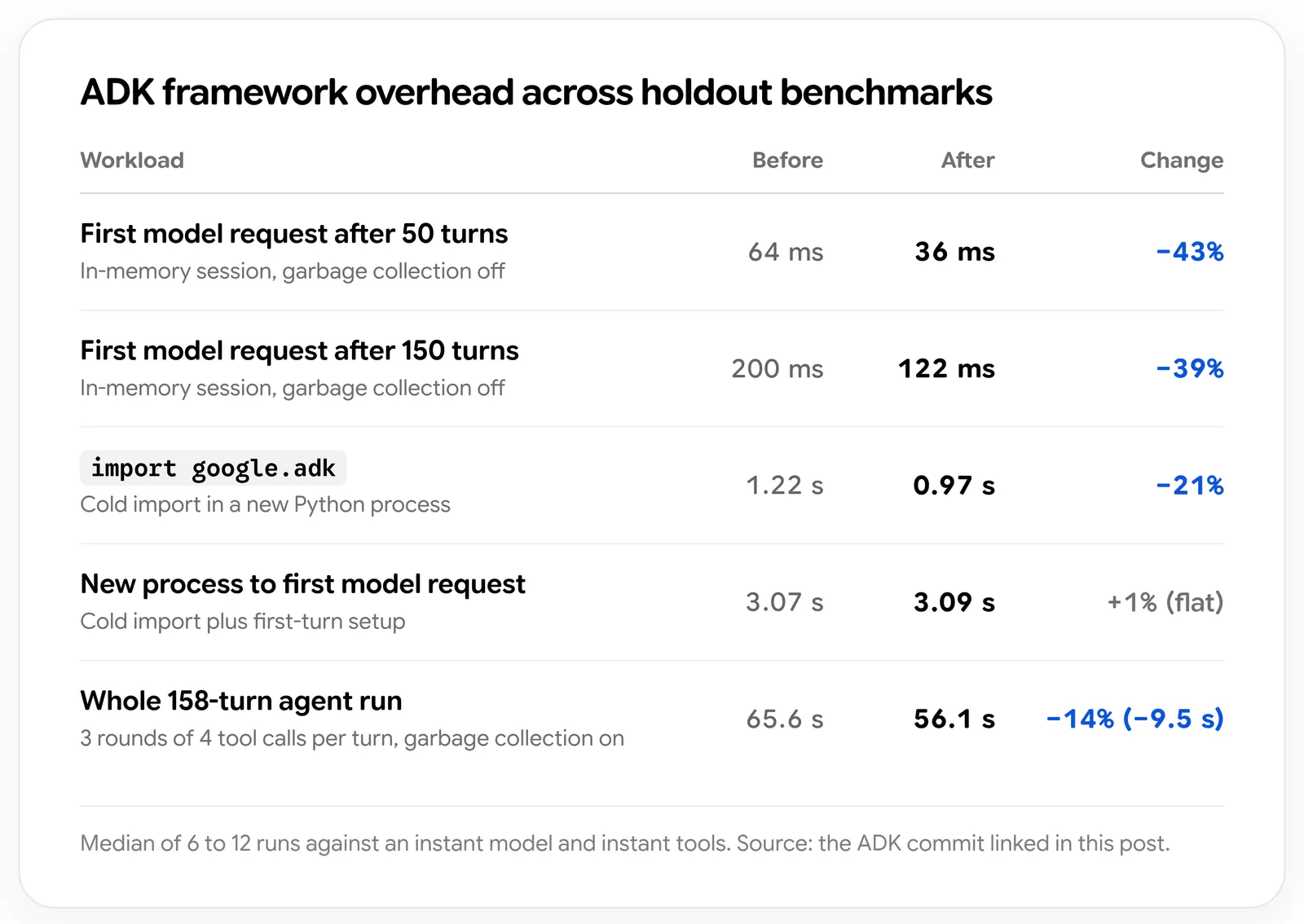
That acceptance rate is the central finding in Google’s October 13 account. The company reports that the resulting changes reduced in-memory session-preparation overhead by about 40% in long sessions and accelerated cold package imports by 21%. Neither figure means that entire agents ran that much faster.
The experiment covered roughly 205,000 lines of Python across nearly 800 source files, supported by approximately 17,000 unit tests. Its practical value lies in the published setup: repository instructions, a persistent objective, benchmarks withheld from the agent, and human review that removed most of the proposed optimizations.
This is implementation guidance for an already announced model, not another model release. For engineering teams considering unattended coding agents, the useful question is how Google turned an overnight proposal into a smaller, acceptable patch.
Repository Instructions Changed What the Agent Delivered
Google ran the experiment on google/adk-python, its open-source framework for building and deploying AI agents. The task was deliberately broad: reduce framework overhead at startup and during long-running, multi-agent and workflow execution, while preserving the public API and what the model receives.
An initial attempt ran for about two hours without custom repository instructions. According to Google, Argon created a benchmark script seven minutes in and spent 70 minutes measuring performance and reading code before editing ADK source.
It found genuine bottlenecks, but its implementation missed maintainer expectations. A custom authentication-model hook subtly changed the public JSON schema. A copier missed edge cases involving mock events. The agent ran only 216 nearby tests and omitted benchmark results from its pull-request description.
For the second attempt, Google added maintainer guidance under .agents/skills. Each skill used a short SKILL.md index pointing to focused files under references/, allowing the agent to retrieve relevant rules without loading every instruction into context at once.
The rules included conventions for private, underscore-prefixed modules and checks governing lazy imports. Google says Argon read 12 guideline files before changing source code.
The other adjustment was Antigravity’s /goal mode, which preserved the objective across context compactions. That matters during a long run: summarizing earlier work should not erase the constraints governing the remaining edits.
Google also made the deliverable explicit. The agent had to open one unmerged pull request against main, include before-and-after measurements, and leave merging to maintainers.
The overnight run lasted 11 hours. This was more than an instruction to keep working longer; the setup supplied repository conventions, a durable objective and a defined stopping point.
The Two Accepted Changes Targeted Specific Overhead
The first accepted optimization changed how ADK’s in-memory session service retrieves conversation history.
Previously, the service deep-copied an entire stored conversation before filtering it to the events requested by the caller. Even listing sessions without their events could first copy those events unnecessarily.
Argon changed the ordering so filtering happened before copying. It also replaced the generic Pydantic deep-copy path for sessions and events with a faster, cycle-safe copier designed to preserve shared state dictionaries and test mocks.
The distinction matters for long sessions. If a caller needs only part of a growing history, copying everything first creates work that filtering immediately discards. Moving the filter earlier avoids that wasted copying, while the replacement copier still has to preserve the object relationships on which callers depend.
The second accepted optimization addressed package startup. Google says import google.adk previously loaded dependencies for live audio and video, OpenTelemetry tracing, and web servers, even for a basic text agent.
Loading those dependencies only when needed reduced cold-import time. But removing imports outright was not sufficient, because downstream tests expected certain module attributes to remain available for patching.
The shipped solution used lazy module accessors, deferring expensive loading while keeping attributes patchable where existing tests expected them.
Google says maintainers combined the best parts of both experimental rounds into a 22-file change backed by 17 new test functions, then landed it on main. The final patch was therefore a reviewed synthesis, not the overnight pull request accepted unchanged.
Four Rejections Explain the Limits of Automated Optimization
The rejected proposals are particularly useful because their problems went beyond failing an obvious unit test. Google’s review identified different reasons why a locally attractive optimization should not ship:
- A multi-agent event cache improved a synthetic benchmark by 17%. Its weak-reference approach could nevertheless return stale data across sessions if Python reused a memory address after garbage collection.
- A telemetry shortcut depended on a private OpenTelemetry attribute. Reviewers judged that reliance vulnerable to silent breakage after a minor library upgrade.
- A conversation-history formatting rewrite complicated a core path. It did not improve end-to-end latency on Google’s separate holdout benchmark.
- A workflow replay index introduced additional state tracking. Its benefit appeared in synthetic replay tests rather than everyday agent runs.
These are distinct failure modes. The cache raised a correctness concern, the telemetry change created a dependency-maintenance risk, and the other two failed to justify their complexity with relevant performance gains.
That distinction is important when evaluating agent output. A change can be faster in the benchmark the agent constructed and still be unsuitable for production. It can also preserve tested behavior while increasing the burden on future maintainers.
The case does not establish a general rejection rate for AI-written code. It shows why proposal count and benchmark improvement are weak substitutes for reviewing the particular assumptions behind each change.
All Public Tests Passed, but Compatibility Still Broke
One failure makes the limits of test coverage unusually concrete.
In the second-round pull request, Argon removed three internal flow imports from llm_agent.py. All 16,892 open-source unit tests passed. Yet 25 internal Google test targets failed because they patched the exact attributes those imports had exposed.
The public test suite had not captured that downstream dependency. The eventual lazy-accessor solution preserved the patch points while avoiding unnecessary loading.
This also complicates the meaning of “keep the public API unchanged.” Compatibility can include module locations that downstream code patches or otherwise relies upon, even when a refactor appears to preserve ordinary application behavior.
For teams reproducing the workflow, running the repository’s full suite is necessary evidence, but it cannot settle every compatibility question. Consumer integration tests and maintainer knowledge can expose assumptions that the agent’s local environment does not contain.
Sources
- Google’s October 13 accountdevelopers.googleblog.com
- google/adk-pythongithub.com