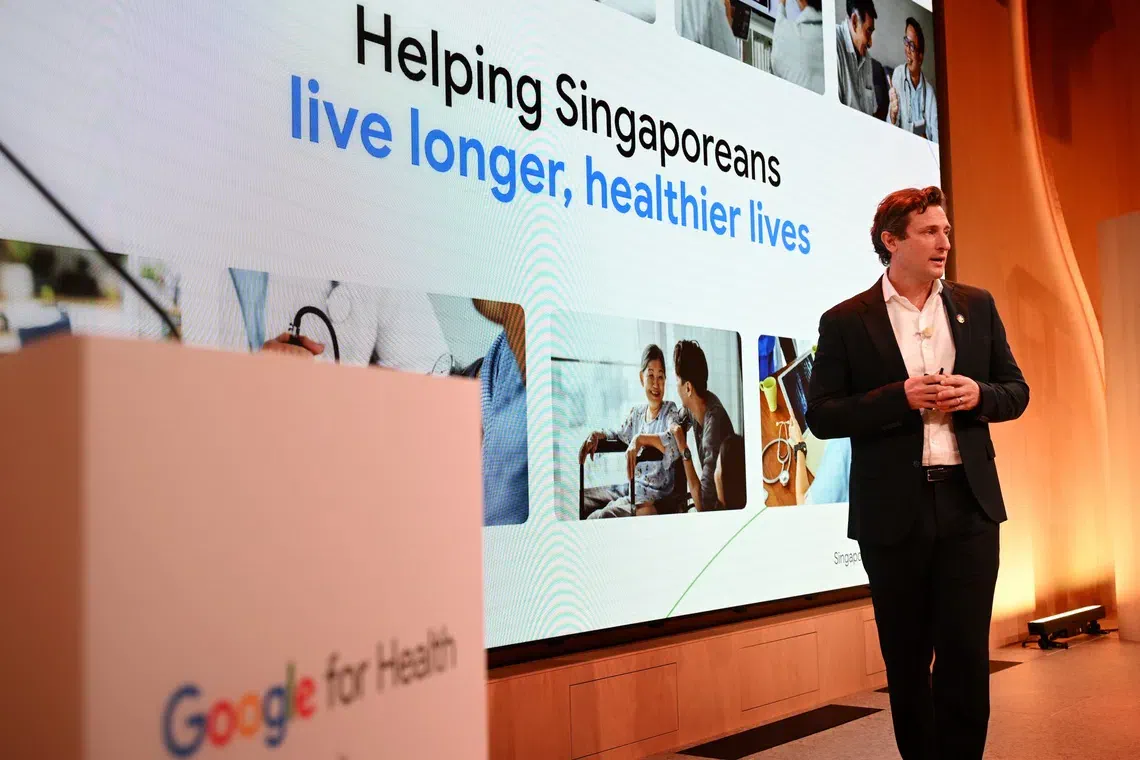
Google announced a new Singapore research hub and several healthcare partnerships on October 29, 2026, at the Google for Health Summit. The package includes local AI research, plans to bring MedGemma models into frontline settings, an AI co-clinician evaluation with the National University Health System, and a population-health program with NHG Health.
The initiatives connect Google to several layers of Singapore’s health system, but they should not be read as a single clinical product launch. The research hub will develop foundational models. The co-clinician work is an evaluation. NHG Health’s resident-facing coach is scheduled for a limited proof-of-concept study in 2027.
Google’s announcement describes a broad ambition to deploy frontier AI across healthcare. Singapore’s health ministry and subsequent reporting provide the more useful operational detail: simulation, staged assessment and conditional expansion.
What Is Research, Evaluation or Deployment?
Google Research, Google DeepMind and Google Cloud have different roles in the announcement. Their Singapore partners also serve different purposes, from academic research to clinical assessment and community prevention.
| Initiative | Organizations involved | Announced stage | Intended work |
|---|---|---|---|
| Singapore research hub | Google Research, with academic partnerships including NUS and NTU | Research capacity being established | Advance foundational AI models and scientific applications |
| MedGemma in frontline settings | Google Research and healthcare collaborators not individually specified in the announcement | Planned expansion of health research and customized solutions | Help developers build locally controlled healthcare AI systems |
| AI co-clinician | Google DeepMind and National University Health System, or NUHS | Evaluation | Synthesize medical guidelines and literature; assist with clinical queries |
| Population-health program and health coach | Google Cloud and NHG Health | Planned proof-of-concept | Forecast health risks and provide personalized preventive guidance |
This breakdown follows Google’s announcement, with the coach’s study status clarified by The Straits Times.
My view is that the most consequential detail is the separation between these stages. Establishing a research team, assessing a clinician-facing system and inviting residents into a pilot create different kinds of evidence. None can substitute for the others.
The Research Hub Builds Local Capacity
The new Google Research hub will consist of local research scientists and software engineers working on foundational AI models to accelerate scientific breakthroughs. Google also names the National University of Singapore and Nanyang Technological University as academic partners for developing scientific talent and providing targeted research support.
The announcement does not specify a headcount, a detailed research agenda or a timetable for particular outputs. Its description is broader than a dedicated clinical-product laboratory: foundational-model research can support scientific applications without immediately becoming a tool used in patient care. Google’s original post establishes the commitment, but leaves those operating details open.
The practical significance is a local team that can work with Singapore’s researchers and institutions over time. That could make collaboration more sustained and locally relevant. It remains an inference about the structure of the initiative, not evidence that the hub has already produced medical breakthroughs.
MedGemma Is a Building Block for Customized Systems
Google says it will expand existing Singapore health research by bringing open models such as MedGemma into frontline care settings. Its stated goal is to enable secure, customized solutions while maintaining data sovereignty.
The distinction between a model and a finished clinical system matters here. A model supplies capabilities that developers can incorporate into an application. The application still needs a defined task, access controls, suitable data handling, a user interface and evaluation in its intended workflow.
Google’s post does not identify the MedGemma version, named deployment sites, specific clinical tasks or validation results for these Singapore implementations. It therefore supports a report about planned model adoption and customization, without supplying enough detail to assess a particular medical application. Source: Google
I would treat the data-sovereignty claim as an implementation requirement to inspect, not an automatic consequence of choosing an open model. Deployment location, logging, external services and access permissions all affect who can handle sensitive information. The announcement gives the intended outcome, but not the architecture needed to assess it.
That leaves an important responsibility with the organizations building on MedGemma: validating their own system for the task and population it will serve.
NUHS Will Evaluate the AI Co-Clinician
Google DeepMind is working with National University Health System to evaluate an AI co-clinician tool. Google describes a system that helps clinicians synthesize medical guidelines and literature, then assists doctors with clinical queries during patient care.
The Straits Times adds that the study will assess the accuracy, safety and usefulness of responses, with clinicians independently evaluating them against established clinical criteria. That is a description of the planned assessment, not a published result showing that the tool has passed it. Read the report.
Singapore’s Ministry of Health provides an additional boundary. In his October 29 summit speech, Senior Minister of State Tan Kiat How described a longer-term direction in which AI could participate in patient-management workflows under physician oversight, beginning in simulation before any progression toward real-world use.
His sequence was explicit:
“So simulation first. Careful observation next. Real-world deployment only when the evidence supports it.”
That distinction becomes more important as a system moves from supplying information toward taking part in care workflows. A useful literature summary and an appropriate patient-management action require different checks. Tan’s speech identifies boundaries, escalation, professional responsibility, error detection and ongoing monitoring as relevant questions.
The published material does not provide the evaluation protocol, sample size, success thresholds or results. Readers therefore cannot yet judge how the co-clinician performs in NUHS workflows or whether it improves care.
The staged approach is sensible because it makes progression conditional on evidence. Its value will ultimately depend on the quality of those evaluations and the safeguards used after any eventual deployment.
NHG Health’s Coach Starts With a Limited Study
NHG Health, a separate partner from NUHS, is working with Google Cloud on population-health prediction and preventive guidance.
Google describes two connected components. Predictive insights would forecast risks, including chronic conditions, across sub-populations. Those insights would feed an AI health coach on NHG HealthBot, using Google’s Gemini Enterprise for Customer Experience platform to provide lifestyle guidance and preventive-care reminders.
The Straits Times supplies the rollout conditions missing from the broad announcement:
- Start: First quarter of 2027.
- Duration: A nine-month proof-of-concept study.
- Participants: A selected group that could include up to a few thousand users, introduced neighborhood by neighborhood.
- Priority groups: People eligible for Healthier SG who have not attended screenings, alongside seniors receiving frailty-prevention support.
Frequently Asked Questions
3 questions
1What Will Google’s Singapore Research Hub Do?
The hub will employ local scientists and software engineers to advance foundational AI models and scientific applications. Google names NUS and NTU as academic partners, but has not specified the hub’s headcount or detailed output timetable.