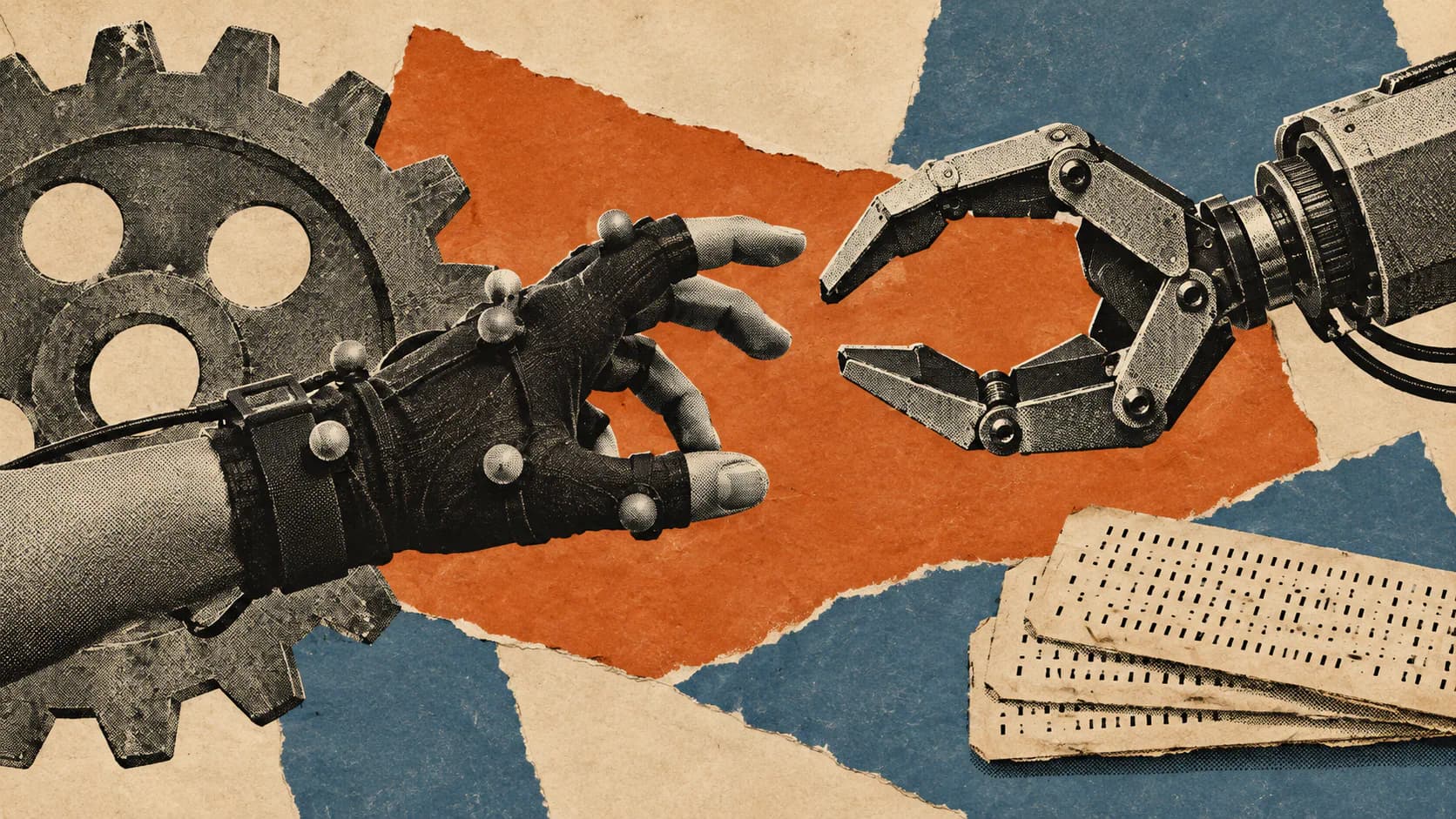
GenRobot AI has completed a $100 million Series A+ funding round, adding substantial capital to the business of recording people performing tasks and preparing those demonstrations for robot training. The Beijing-based company’s financing closed in the third quarter and was disclosed on November 2, 2026, according to TechNode’s report.
The company builds recording systems that capture visual information alongside hand and body movements across household, manufacturing, and logistics tasks. Its Matrix platform then synchronizes, cleans, and labels those recordings for robot developers.
That combination explains the infrastructure angle. Collecting footage is one part of the job. Making different sensor streams describe the same action, identifying unusable recordings, and preparing consistent training examples are separate engineering problems. GenRobot is positioning itself across that pipeline.
The most revealing technical detail concerns what its cameras cannot see. A secondary account of GenRobot’s technical work describes reconstructing whole-body movement from partial observations, while acknowledging difficulties with fast motion, blocked views, and complex contact. That makes the funding story a bet on data processing and reconstruction as much as data collection.
The Round Backs a Robot-Data Supplier
Participants included SAIC Motor, Malaysia’s Eastworlds, Baidu, Shoucheng Holdings, and Galaxy General Robotics, alongside financial investors GL Ventures, CITIC Goldstone, CCB International, and Huatai Zijin, TechNode reported.
The reviewed reporting identifies neither a single lead investor nor a valuation. It also provides no detailed allocation of the proceeds, so the round should not be described as a confirmed budget for particular facilities, equipment purchases, or hiring plans.
Captables identifies the business as Jianzhi Robotics, operating as GenRobot.AI, and reports that the financing follows an earlier Series A led by Momenta, announced on August 26.
The presence of automotive, AI, and robotics investors gives the round strategic relevance. Still, an investment is not evidence of a customer contract or a deployed integration. The disclosed investor list shows who is backing the business, without revealing how those organizations might use its data.
My view is that the clearest signal is the size of the commitment to a supplier that sits upstream of robot deployment. Investors are financing the production and preparation of training material, a layer that can potentially serve multiple robot developers without GenRobot having to build every end-use machine itself.
Why Human Demonstrations Need a Processing Pipeline
Human demonstrations can provide examples of how people move and handle objects during a task. For robot developers, their usefulness depends on how completely and consistently those examples are recorded.
Consider a person lifting an object from a shelf. Images may show the object and surrounding space, while motion records describe the person’s hand and body position. If those streams are offset in time, an image captured before contact could be paired with movement recorded after the grasp. The resulting example would contain a misleading relationship between what was visible and what happened next.
That is the practical purpose of synchronization: keeping different observations aligned to the same event.
GenRobot’s official Gen Matrix platform page describes several processing functions:
- Automated cleaning: identifying anomalies, reducing noise, and filling in missing information.
- Multimodal and multi-device alignment: synchronizing streams that can include hand movement, vision, and touch.
- Scene reconstruction: processing aligned observations to represent details of the physical environment.
- Automated annotation: adding labels through automation and crowdsourcing.
- Model evaluation support: connecting data preparation with the assessment and iteration of robot models.
These are the company’s descriptions of its platform. The page’s reference to touch data should not be read as confirmation that every demonstration includes tactile measurements.
Each stage addresses a different failure mode. Cleaning concerns the condition of the recordings. Alignment concerns whether observations belong together in time. Annotation concerns how an example is described and made usable downstream.
Those distinctions matter commercially. A supplier could collect a large volume of demonstrations yet still leave customers with substantial work if timestamps are unreliable or labels are inconsistent. Conversely, a smaller collection might be useful for a narrowly defined task if it captures the relevant actions clearly. This is why recording volume alone is an incomplete measure of robot-data infrastructure.
The Hard Part Is Recovering Motion the Camera Missed
A head-mounted camera follows the demonstrator’s viewpoint, but that viewpoint does not necessarily include the whole body. Hands may enter and leave the frame, objects may block the view, and the lower body can remain unseen during a task.
According to Captables’ summary of GenRobot’s September 8 technical post, the company describes reconstructing movement from partial observations to create fuller training examples. The same summary reports acknowledged difficulties involving fast motion, occlusion, and complex contact between people and objects.
The original technical post was not among the opened sources, so this account of the reconstruction work rests on Captables’ secondary summary.
The consequential distinction is between recorded movement and inferred movement. When a camera cannot see part of an action, reconstruction supplies an estimate of what happened. That can make incomplete demonstrations more useful, but it also introduces a question about how confidently the missing motion can be recovered.
A plausible-looking reconstruction is not automatically an accurate record of the action. Several body positions could potentially fit a partial view. Fast movement and blocked sightlines can leave fewer visible clues, while contact introduces questions about exactly when and how a person interacted with an object.
For a dataset buyer, I’d want reconstructed segments to be distinguishable from directly observed ones. That would make it easier to decide which examples are suitable for training and which are appropriate for evaluation. The opened sources do not explain whether GenRobot exposes that distinction to customers.
This is a more useful test of the business than simply asking how many demonstrations it can collect. If reconstruction improves the usable yield from partial recordings, it could make collection more productive. If uncertain estimates are treated as reliable observations, processing could also introduce errors into the finished dataset. Those are analytical possibilities, not measured outcomes for GenRobot.
What Matrix’s Performance Claims Actually Tell Us
GenRobot presents Matrix as an automated data-processing system and advertises several headline figures on its platform page. They need to be read with their missing conditions in mind.
| Published vendor claim | What remains unclear in the available page text |
|---|---|
| 10× efficiency improvement | The comparison baseline, workload, hardware, and amount of human work included |
| 99.9% accuracy | What is being measured, the reference standard, and performance across different tasks |
| One high-quality data item uploaded every 3–6 seconds on average | The size and duration of an item, and whether the interval includes capture, processing, or review |
These are vendor figures, not independent measurements. The available material does not establish commercial scale, customer adoption, or dataset quality.
Frequently Asked Questions
4 questions
1How much funding did GenRobot AI raise?
GenRobot AI completed a $100 million Series A+ round. It closed in the third quarter and was disclosed on November 2, 2026, according to TechNode.