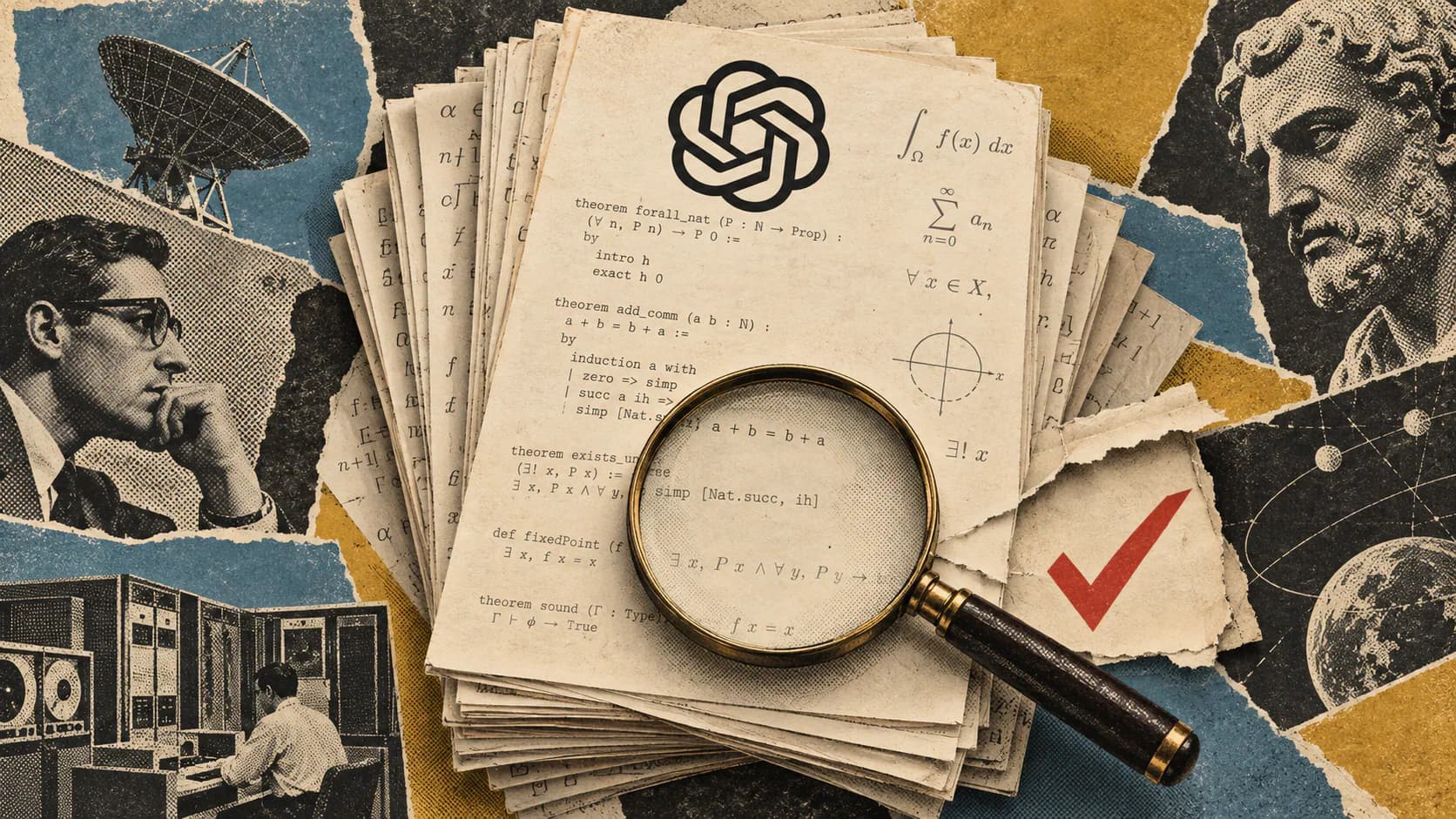
OpenAI’s public mathematics repository warns that its 722 AI-generated mathematical manuscripts sit at different stages of verification. Not every manuscript has a Lean formalization, and some unformalized results could contain issues.
Released on October 6, 2026, the collection was produced by an unreleased internal model. It spans 372 related result families and includes manuscripts, source files, formal proof artifacts, and selected summaries of the model’s reasoning.
This is a public verification event, not a model launch. Mathematicians now have concrete arguments to examine beyond the company’s description of its system’s capabilities. How much of the output will survive checking, establish genuinely new results, and become mathematics that other researchers understand well enough to use remains unresolved.
722 Manuscripts Do Not Mean 722 Separate Discoveries
OpenAI defines a “family” as a group of related papers that can include a principal result, companion arguments, consequences, or alternative proofs. Several manuscripts may therefore belong to the same underlying mathematical development. Neither 722 manuscripts nor 372 families is an independently established count of solved open problems.
The collection provides several ways to inspect its claims. An overview describes the families, a manuscript map connects individual papers to supporting materials, and the preprints directory contains PDFs, source files, and manuscript-specific citation and build instructions. Separate Lean materials document the available formal proofs and their verification configurations.
Subjects listed for the released reasoning summaries include the irrationality exponent of π, correlations of multiplicative functions, diluted spin glasses, and the three-dimensional relativistic Vlasov–Maxwell system. These labels illustrate the collection’s breadth; they do not confirm that every associated claim is correct or resolves its broad research area.
With the papers public, experts can inspect theorem statements, assumptions, citations, and arguments. They can ask whether a claimed result matches the original problem and whether earlier literature already contains the relevant ideas. Answering those questions requires scrutiny of individual manuscripts and result families, not a count of files.
Lean Support Helps, but Its Scope Must Be Checked
Many manuscripts have accompanying Lean formalizations, according to OpenAI’s README. A formal proof artifact can provide a computer-checkable argument, reducing reliance on a reader’s interpretation of mathematical prose. Still, “has Lean support” is not a blanket certification of everything in a paper.