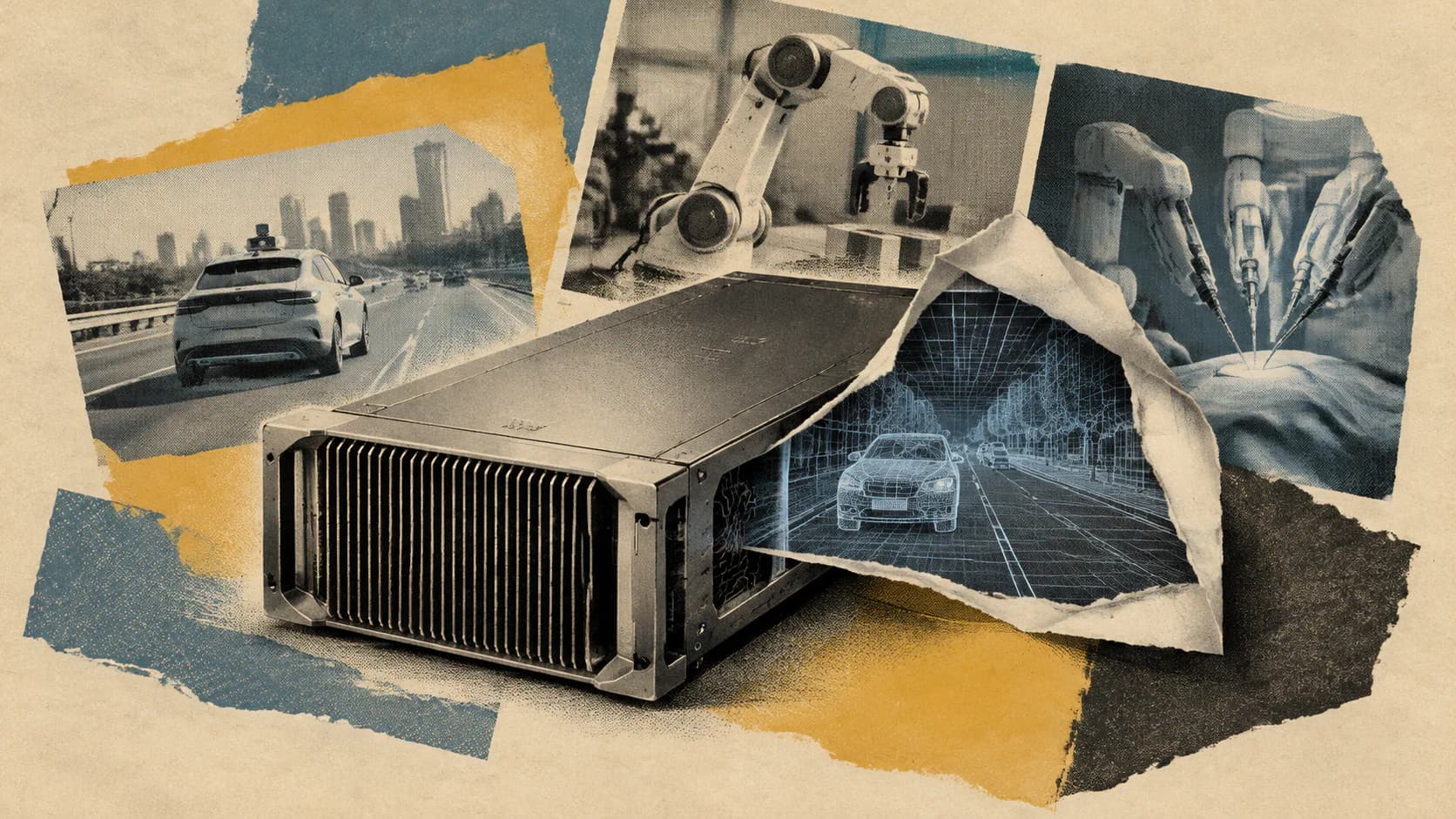
NVIDIA published a practical Cosmos implementation guide on November 2, 2026, covering how developers can adapt world models and deploy them for autonomous-vehicle, robotics and surgical simulation. The update is implementation guidance for existing Cosmos components, not the launch of a new foundation model.
The guide connects two parts of the development process. Cosmos Framework supplies recipes and agent skills for data processing, training, optimization and inference. Cosmos NIM microservices provide GPU-accelerated serving through application APIs.
For teams evaluating physical-AI tools, the useful change is the path from an available checkpoint to a working experiment: select the appropriate generation behavior, configure the hardware, produce observations, inspect them and then connect the model to an application. That sequence also exposes where a successful demonstration stops short of a validated simulator.
Choose the Checkpoint Around the Experiment
NVIDIA describes Cosmos Framework as modular, with support expanding beyond Cosmos 3 to models including Alpamayo, GR00T, Qwen and pi0.5. Compatibility depends on the checkpoint and recipe; the list should not be read as a promise that every model supports every workflow.
The simulation recipes address several distinct jobs. Explainx’s detailed walkthrough of the NVIDIA guide breaks them down as follows:
| Development task | Checkpoint | Documented role |
|---|---|---|
| Offline driving data | Cosmos3-Nano-Transfer-Auto | Generates an entire multi-view clip using bidirectional denoising |
| Closed-loop driving simulation | Cosmos3-Nano-Sim-Auto | Generates observations causally as a policy or human changes the scenario |
| Robot visual variation | Cosmos3-Nano-Sim-Transfer | Converts depth video into RGB scenes with different appearances while preserving geometry and motion |
| Interactive two-arm robot simulation | Cosmos3-Nano-Sim-Bimanual | Generates the next observation from the scene and robot actions, supporting YAM and AgiBot embodiments |
| Offline surgical data and policy checks | Cosmos3-H-Embodied-Nano | Generates surgical video from robot actions, predicts actions from video, or combines both |
| Interactive surgical simulation | Cosmos3-H-Dreams | Uses a causal, few-step model distilled from H-Embodied-Nano to generate frames from live kinematics |
The consequential distinction is offline generation versus closed-loop interaction.
Transfer-Auto can process a whole clip together. That suits building a synthetic dataset before training or evaluating another system. Sim-Auto instead produces observations as actions arrive, allowing a driving policy to influence what happens next.
I’d make that distinction before comparing output quality. A visually convincing offline clip cannot tell you how a simulator responds when a policy changes direction halfway through an episode. Conversely, a closed-loop workflow needs predictable response times as well as plausible frames.
NVIDIA says the example simulation checkpoints support PyTorch and vLLM-Omni and were tested on Hopper and Blackwell GPUs. The selected recipe determines GPU count, memory configuration and inference settings.
Synthetic Data Starts With Controlled Variation
The autonomous-vehicle recipes accept prompts and World Scenario Map, or WSM, controls describing lanes, objects, road markings, signs and road boundaries. Joint camera-and-LiDAR generation also uses HD-map rangemap controls and can take initial LiDAR observations. Optional initial camera images provide visual context.
Prompts describe weather, lighting, time of day and road conditions, with prefixes supplying camera-rig and field-of-view context. This gives developers a way to vary a scene’s appearance while retaining structured controls over its layout.
NVIDIA’s example changes a daytime drive into a rainy nighttime scene while keeping the road layout and vehicle trajectories, according to the published walkthrough. That is a useful synthetic-data application: a perception team can investigate whether a system’s behavior changes under different visibility conditions without intentionally changing the entire scenario.
The robotics transfer recipe serves a related purpose. Depth video supplies geometry and motion, while generation changes lighting, textures and backgrounds. My view is that this controlled variation is more useful than collecting visually diverse clips without knowing which conditions changed. It gives an experiment a clearer variable to investigate.
That control still needs checking. A prompt requesting rain does not prove that every camera view depicts consistent rain, reflections or visibility. Likewise, intended preservation of geometry needs verification in the generated output.
Validate Files, Sensors and Policy Behavior Separately
NVIDIA’s Transfer-Auto reference run uses four GPUs and a sample containing seven synchronized camera videos, per-camera captions, first-frame RGB conditioning and HD-map LiDAR controls. The reported output comprises seven 720p videos, each with 297 frames at 30 frames per second, plus 99 LiDAR sweeps.
Those figures contain a useful implementation detail. Each video represents approximately 9.9 seconds, calculated as 297 frames divided by 30 frames per second. The camera-frame and LiDAR-sweep counts differ, so downstream software cannot simply assume one LiDAR sweep corresponds to each video frame. It needs to preserve and check temporal alignment.
The walkthrough reports NVIDIA’s specific output checks: inspect sample_outputs.json for success, check lidar.safetensors for finite range and intensity values, and verify alignment and consistency across camera views and LiDAR.
These checks address different failure modes:
- Output integrity: Did generation finish and produce the expected artifacts?
- Numerical validity: Do sensor tensors contain usable values instead of invalid numbers?
- Cross-sensor consistency: Do cameras and LiDAR agree about the same scene?
- Behavioral usefulness: Does the generated environment support the experiment the team intends to run?
The final layer is an analytical implication, not a reported NVIDIA test result. Files can pass numerical checks while depicting inconsistent geometry. A coherent scene can still produce misleading policy evaluations if its response to actions differs from the target environment.
For surgical workflows especially, generated video and action prediction should be treated as development tools. Real-world suitability requires separate application-specific evidence.
Adapt the Model With Bounded Agent Tasks
Cosmos Framework supports LoRA, which adapts a limited set of parameters, and full supervised fine-tuning, which updates all model parameters. NVIDIA lists JSONL, WebDataset, LeRobot and custom adapters as supported data-loading options.
The framework also covers offline preference optimization, online reinforcement learning, on-policy distillation and diffusion-model reinforcement learning. These are options for different training problems, not a sequence every team needs to complete.
NVIDIA places setup, inference, post-training and troubleshooting skills under .agents/skills. Its example agent task includes several useful constraints:
- Pin model, code and data revisions.
- Validate the dataset and separate training episodes from evaluation episodes.
- Run a smoke test and save the configuration.
- Stop at a specified GPU-hour budget.
- Compare the adapted checkpoint with the base model on held-out data using three seeds.
- Repeat evaluation at a supported lower precision, recording quality, peak memory and latency.
Frequently Asked Questions
3 questions
1Is This a New Cosmos Model Release?
No. The November 2 guide explains implementation workflows using released Cosmos components and checkpoints, including simulation recipes and NIM deployment.