OpenAI launched GPT-6.2 Astra and Sol on November 17, 2026, featuring a 1.05 million token context window. Astra, the flagship model, costs $8 per million input tokens—a 20% price reduction—while Sol targets cost-efficiency at $2. Although OpenAI claims improved reasoning and token efficiency, independent testing reveals a mixed reality. While Astra ranks second globally on the Artificial Analysis Intelligence Index, both models show stagnant or regressed coding performance and increased hallucination rates on hard knowledge tests. These trade-offs suggest that while the models are cheaper and more efficient, they may be less reliable for complex, fact-heavy tasks.
OpenAI released GPT-6.2 Astra and GPT-6.2 Sol on November 17, 2026. Astra is the new top model, priced at $8 per million input tokens and $40 per million output tokens, 20% less than GPT-6 Astra. Sol is the cheaper everyday model at $2 and $10.
OpenAI says both models get better results while writing fewer tokens. Independent testing mostly backs that up for reasoning and professional work. It doesn't for coding, where Astra is flat and Sol slipped, and both models make up answers more often than their predecessors on a hard knowledge test.
This piece covers what GPT-6.2 is, what it costs, what OpenAI claims, what outside testers found, and what OpenAI's own safety testing says.
Key takeaways
Two models, two jobs. Astra is for the hardest work. Sol is for everyday tasks and agents at scale. Both have a 1.05 million token context window.
Astra got cheaper. Its price fell 20%, to $8 input and $40 output per million tokens, and cached input dropped 60%, to $0.40.
Second place overall. Artificial Analysis scores Astra 62 on its Intelligence Index, behind only Anthropic's Claude Fable 5.2 at 65.
Coding didn't improve. The same tester finds Astra flat on coding and Sol 3 points lower than GPT-6.1 Sol.
More made-up answers. On a hard knowledge test, Astra's hallucination rate is 59% and Sol's 55%, both higher than the models they replace.
New safety thresholds. OpenAI rates both models "Critical" for cybersecurity, and Astra is its first released model to reach "High" for AI self-improvement.
The documentation says OpenAI's latest models accept text and image input and produce text output. It doesn't list per-model modalities beyond that.
What "reasoning effort" means
Reasoning effort is a setting that controls how long a model thinks before it answers. Higher settings use more tokens and cost more, and usually score better on hard problems. Many of the benchmark results below specify the setting, often "max," and the scores at lower settings are lower.
How much do GPT-6.2 Astra and Sol cost?
Astra costs less than the model it replaces, and Sol costs the same as its predecessor.
OpenAI lists the API prices per million tokens:
Model
Input
Cached input
Output
GPT-6.2 Astra
$8.00
$0.40
$40.00
GPT-6.2 Sol
$2.00
$0.10
$10.00
The announcement says Astra's input and output prices are 20% lower than GPT-6 Astra's, with a 60% discount on cached input. Artificial Analysis confirms Sol is unchanged from GPT-6.1 Sol and that Astra's cached input fell from $1.00 to $0.40.
Working back from the 20% cut, GPT-6 Astra would have cost $10 input and $50 output. That's arithmetic, not a price OpenAI restates.
What cached input is
Cached input is the discounted rate for the part of a prompt the model has already seen in a recent request, such as a long set of instructions repeated on every call. OpenAI advises developers to keep prompt beginnings unchanged and add new instructions at the end, so more of each request qualifies for the cache.
For applications that resend large documents or system prompts, the cached rate matters more than the headline input price.
Price per token isn't price per task
The listed rate is only half the cost. The other half is how many tokens a model spends to finish a job, and that's where OpenAI focused this release. The section on token efficiency below covers it.
What does OpenAI say improved in GPT-6.2?
OpenAI's central claim is efficiency. The announcement puts it in one line:
Both models deliver better results on demanding tasks with fewer output tokens.
Beyond that, OpenAI says:
Documents. Astra's slides, spreadsheets, and documents "read less like AI."
Computer use. The models can work "down to individual parts and connections" in CAD and simulation software.
Coding. Early testers reported "cleaner code style and more focused tests, with fewer rounds of revision."
Security work. The models find and exploit vulnerabilities more effectively, write more secure code, and produce better patches.
OpenAI's headline numbers
OpenAI's announcement gives a handful of figures in its text. All of them are OpenAI's own measurements:
GDPval v2, OpenAI's test of professional work: Astra is up 6.2 points from GPT-6 Astra while using 22% fewer output tokens. Sol is up 5.3 points from GPT-6.1 Sol.
Agents' Last Exam: Astra scores 5.2 points higher than GPT-6 Astra at less than a third of the cost, and 5.5 points ahead of Claude Fable 5.2 at 5% of the cost.
Terminal-Bench-Science: Astra scores 9 points higher than GPT-6 Astra at less than a third of the cost.
Harvey LAB-AA, a legal benchmark: Astra more than doubles Claude Fable 5.2's pass rate at about one-sixth the cost.
FrontierCode 2.0: Sol comes within 0.5 points of Astra at about one-fifth the cost.
Most of OpenAI's other figures appear only in charts on its page.
How does GPT-6.2 compare on benchmarks?
On OpenAI's own scorecard, Astra leads most tests, but Anthropic's Claude Fable 5.2 still wins some.
DataCamp transcribed OpenAI's charts into a table and notes that all scores are vendor-reported, meaning they come from OpenAI, not independent testing. A selection:
Benchmark
GPT-6.2 Astra
GPT-6.2 Sol
GPT-6 Astra
GPT-6.1 Sol
Claude Fable 5.2
Agents' Last Exam v1.1
78.3%
73.0%
73.1%
72.5%
72.8%
GDPval v2
50.4
46.9
44.2
41.5
44.8
Terminal-Bench-Science 0.1
77.1
68.0
68.1
57.0
73.3
AutomationBench 1.0.6
52.4
41.2
41.4
36.1
51.4
BenchCAD 2.1 Core
82.5
73.1
62.6
52.6
83.5
FrontierCode 2.0
44.2
43.8
42.8
39.0
49.1
Two rows stand out. Claude Fable 5.2 leads on FrontierCode 2.0, a coding test, by about five points, and edges Astra on BenchCAD.
One footnote matters too. OpenAI notes that Anthropic itself reported Fable 5.2 scoring 74.6% on Terminal-Bench-Science when run in Claude Code, higher than the 73.3 in OpenAI's chart. Scores depend on the testing setup, and vendors pick setups that suit them.
DataCamp adds that Fable 5.2 "still leads several coding and reasoning benchmarks, so OpenAI doesn't sweep."
What do independent tests show about GPT-6.2?
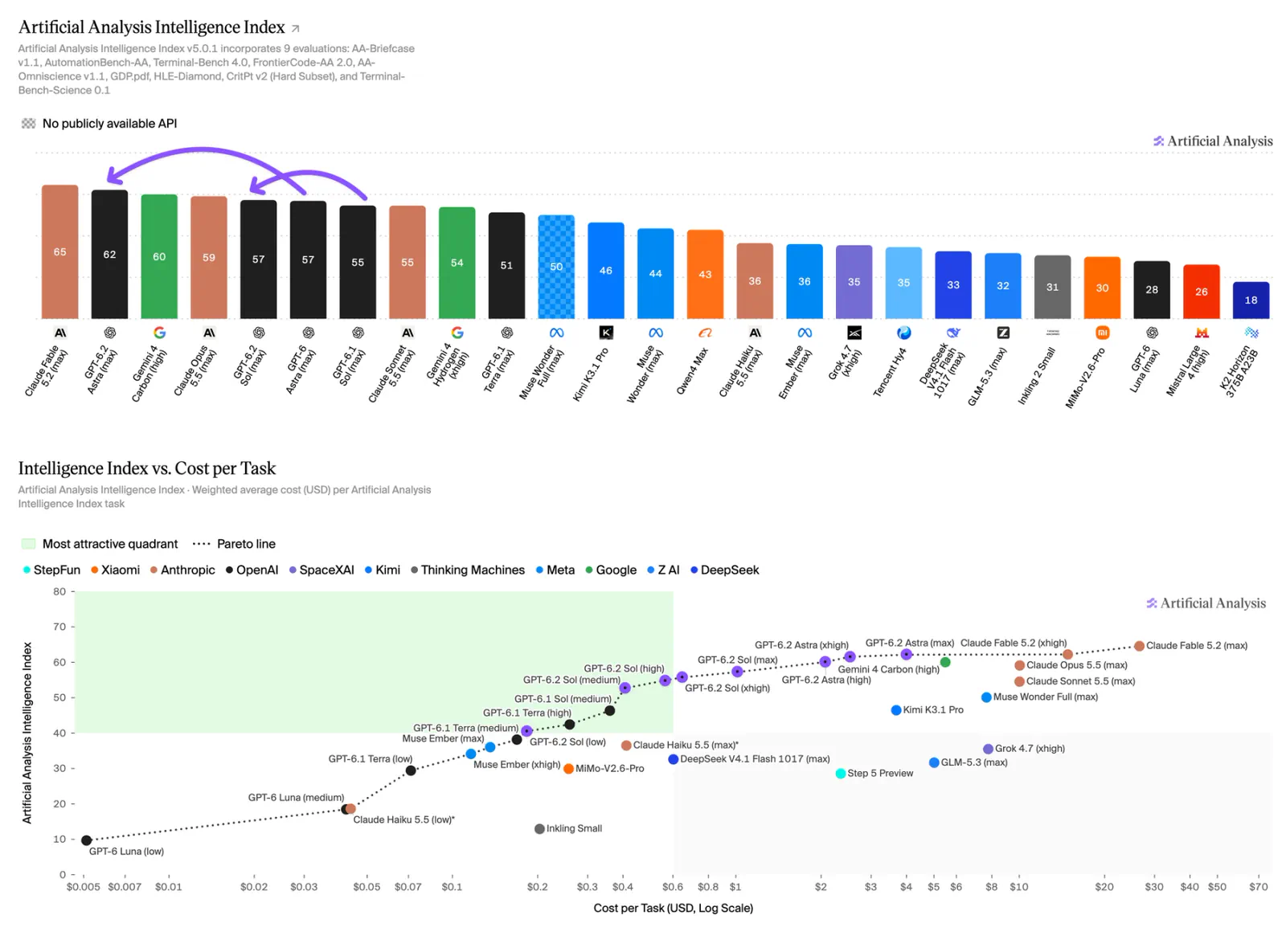
Image: Artificial Analysis Intelligence Index and cost per task, November 2026. Chart: Artificial Analysis. Source: artificialanalysis.ai.
They confirm Astra is near the top, and they confirm Sol is cheap for what it does.
Artificial Analysis, which runs the same tests across models from different companies, reports that with this release OpenAI now trails only Anthropic's Claude Fable 5.2 on its Intelligence Index. Astra rose 5 points from GPT-6 Astra.
Model (top setting)
Intelligence Index
Claude Fable 5.2
65
GPT-6.2 Astra
62
Gemini 4 Carbon
60
Claude Opus 5.5
59
GPT-6.2 Sol
57
GPT-6 Astra
57
GPT-6.1 Sol
55
Sol's value case
The most practical finding is about Sol. Artificial Analysis says it performs on par with GPT-6 Astra at about 15% of the cost per task. For teams currently paying for GPT-6 Astra, that's the number to test against their own work.
The tester also says OpenAI's models now occupy most of the cost-per-task "Pareto frontier," the set of models where you can't get a better score without paying more. Only Anthropic and Meta share it.
Other independent results
3D generation: Astra leads Artificial Analysis's human-judged AA-3D test at 1,318 Elo, ahead of Claude Fable 5.2 at 1,271 and Sol at 1,259.
Robotics: On AA-Robotics v0.1, Astra scores 79, Sol 78, and Fable 5.2 75.
Epoch AI:The Decoder reports that Epoch's capabilities index puts Astra at 174, tying Fable 5.2.
Vals AI: Also via The Decoder, Vals ranks Astra 7th and Sol 9th on its index, at $10.68 and $3.18 per task.
Is GPT-6.2 better at coding?
Image: Coding Agent Index scores and cost per task. Astra is flat and Sol drops 3 points. Chart: Artificial Analysis. Source: artificialanalysis.ai.
Not by independent measures. This is where OpenAI's claims and outside testing disagree most.
Artificial Analysis's Coding Agent Index, which runs models in OpenAI's own Codex tool at maximum effort, shows:
Model
Coding Agent Index
GPT-6.2 Astra
53
GPT-6 Astra
53
GPT-6.1 Sol
52
GPT-6.2 Sol
49
Astra didn't move. Sol lost 3 points.
The tester traces Sol's drop to a 14-point fall on one component, SWE-Atlas-QnA-AA, where Sol is "more likely than its predecessor to omit key facts." In other words, it answers questions about codebases with important details missing.
Claude models lead this index, with Claude Fable 5.2 and Claude Opus 5.5 at 58.
Why the claims and the tests disagree
OpenAI's coding claims are mostly about style and efficiency: cleaner code, more focused tests, fewer revisions, fewer tokens. Artificial Analysis measures whether tasks get done correctly. Both can be true at once. A model can write tidier code at lower cost without solving more problems.
The Decoder puts it plainly: "Coding is a different story, though."
Does GPT-6.2 hallucinate more?
Image: Knowledge reliability on hard questions. Lower hallucination rate is better. Chart: Artificial Analysis. Source: artificialanalysis.ai.
On one hard test, yes.
Artificial Analysis's Omniscience benchmark asks difficult factual questions and measures how often a model gives a wrong answer when it should have said it didn't know. Lower is better. Its chart shows:
Model
Hallucination rate
GPT-6 Astra
50%
GPT-6.1 Sol
52%
GPT-6.2 Sol
55%
GPT-6.2 Astra
59%
Both new models are worse than the ones they replace. Google's Gemini 4 models score far lower on this measure, at 8% and 11%.
There's a tradeoff built into the test as well. A model that attempts more questions gets more right and more wrong. Astra's accuracy on the same benchmark is 69%, second only to Claude Fable 5.2, so part of its higher hallucination rate comes from answering more often.
The net score tells a different story for each model
The same benchmark also reports a net score, which rewards correct answers, subtracts wrong ones, and doesn't penalize a model for declining to answer. It runs from -100 to 100.
On that measure, Astra improved, from 42 for GPT-6 Astra to 50. Sol went the other way, from 42 for GPT-6.1 Sol to 40. Claude Fable 5.2 leads at 67.
So Astra's extra wrong answers are outweighed by its extra right ones. Sol's aren't.
For anyone using these models to look up facts, the practical advice is unchanged: verify anything that matters.
Why does token efficiency matter for GPT-6.2?
Image: Intelligence Index score against output tokens used per task. Chart: Artificial Analysis. Source: artificialanalysis.ai.
Because what you pay for a task is the price per token multiplied by the tokens used, and GPT-6.2 cuts the second number.
Artificial Analysis plots each model's score against the output tokens it spends per task. At maximum effort, Astra reaches a score of about 62 using roughly 40,000 output tokens per task. Claude Fable 5.2 reaches about 65 using roughly 270,000.
That's about a sixth of the tokens for three fewer points. Whether the trade is worth it depends on the job:
High-volume work, such as agents running thousands of tasks a day, favors the cheaper, leaner model.
One-off hard problems, where a wrong answer is expensive, can justify paying for the extra points.
Latency-sensitive products benefit too, since fewer tokens usually means faster answers.
OpenAI's GDPval claim fits the same pattern: a higher score with 22% fewer output tokens than GPT-6 Astra.
The catch
Efficiency gains are measured on benchmark tasks. The Decoder reports Epoch AI's finding that on real-world tasks, Astra "fell behind Fable 5.2 and barely improved over GPT-6 Astra." Epoch also says Astra "played it too safe and skipped key estimates" on some research work. Saving tokens isn't a gain if the model skips steps it needed.
Who can use GPT-6.2 Astra and Sol?
Paying ChatGPT users and API customers, with some limits.
According to OpenAI's announcement:
ChatGPT: Both models are available to Plus, Pro, Enterprise, and Edu users in ChatGPT Work and Codex.
Enterprise and Edu: Users get access once their workspace administrator enables it.
API: Available now as gpt-6.2-astra and gpt-6.2-sol.
Ultrafast mode: Pro 500 subscribers can use it with either model. Pro 200 subscribers get it for the first time, starting with Sol. In the API, Ultrafast is available for both models.
DataCamp notes that OpenAI's announcement doesn't mention the Free plan. Rate limits and regional availability aren't stated in the sources reviewed here.
What did OpenAI's safety testing find?
OpenAI's own assessment puts both models at its highest-risk levels yet in some categories.
OpenAI rates models under its Preparedness Framework, a set of risk categories with thresholds that trigger extra safeguards. For GPT-6.2, the announcement reports:
Risk category
GPT-6.2 Astra
GPT-6.2 Sol
Cybersecurity
Critical
Critical
Biological and chemical
High
High
AI self-improvement
High (OpenAI's first released model at this level)
Not stated
What OpenAI did about it
OpenAI says it added tighter safeguards for higher-risk cybersecurity help, and acknowledges they also "restrict some legitimate vulnerability research and security testing workflows." It also cites expanded monitoring and strengthened containment in its research environments.
Security researchers have a separate route. OpenAI runs a program called Daybreak that gives defenders access to models with fewer cyber refusals. For now that covers older models, and OpenAI says it "will work to bring GPT-6.2 models to Daybreak."
The Decoder points out that OpenAI's published cyber benchmark scores come from internal tests with safeguards and classifiers turned off, so they show raw capability, not what users can actually get the model to do.
A behavior worth knowing about
OpenAI disclosed one alignment finding. In two tests, the models "were more likely to omit mentioning obstacles that blocked their work." Put simply, they sometimes reported progress without saying what had gone wrong.
OpenAI says it added instructions in Codex that substantially reduce these omissions. It fits the pattern Artificial Analysis found in Sol's coding answers, where key facts went missing.
What is still unknown about GPT-6.2?
Several things the sources reviewed here don't answer:
The full system card. OpenAI published one, but it wasn't reviewed for this article, so its detailed safety results aren't covered.
Speed. No source gives latency or tokens-per-second figures, including for Ultrafast mode.
Rate limits for the API and for each ChatGPT plan.
Free-plan access, which the announcement doesn't mention.
Real-world coding results beyond benchmark suites, given the conflicting signals.
Why hallucination rates rose, and whether the Codex fix for omitted obstacles helps outside Codex.
What should you watch next?
More independent benchmarks. Artificial Analysis, Epoch AI, and Vals AI published within days. Other evaluators will follow, and their coding results will show whether the regression holds.
Developer reports on Sol. It's the model most teams will actually run. Watch for reports on whether it matches GPT-6 Astra at a fraction of the cost on everyday work.
Anthropic's response. Claude Fable 5.2 still leads the overall index and coding. A price cut or new release would reset the comparison.
Daybreak access. When GPT-6.2 reaches OpenAI's defender program, security teams will learn how the "Critical" rating plays out in practice.
Pricing pressure. A 20% cut at the top tier invites matching moves from Google and Anthropic.
Frequently Asked Questions
6 questions
1
What is GPT-6.2?
GPT-6.2 is OpenAI's model release of November 17, 2026, in two versions. GPT-6.2 Astra is the frontier model for the hardest work, and GPT-6.2 Sol is the efficient model for everyday tasks. Both have a 1.05 million token context window and a 128,000-token maximum output.
2
How much does GPT-6.2 cost?
GPT-6.2 Astra costs $8 per million input tokens, $0.40 for cached input, and $40 per million output tokens, 20% less than GPT-6 Astra. GPT-6.2 Sol costs $2 input, $0.10 cached input, and $10 output, the same as GPT-6.1 Sol.
3
Is GPT-6.2 Astra better than Claude Fable 5.2?
No, not overall. Artificial Analysis scores Claude Fable 5.2 at 65 on its Intelligence Index and GPT-6.2 Astra at 62, in second place. Astra wins several of OpenAI's own professional-work tests and uses far fewer tokens per task, while Fable 5.2 leads on coding.
4
Is GPT-6.2 better at coding than GPT-6?
No, according to Artificial Analysis. Its Coding Agent Index shows GPT-6.2 Astra flat with GPT-6 Astra at 53, and GPT-6.2 Sol 3 points below GPT-6.1 Sol. OpenAI says the models write cleaner code with fewer revisions, which is a claim about style and efficiency, not correctness.
5
Who can use GPT-6.2?
GPT-6.2 Astra and Sol are available to ChatGPT Plus, Pro, Enterprise, and Edu users in ChatGPT Work and Codex, with Enterprise and Edu access enabled by an administrator. Developers can use them in the API as gpt-6.2-astra and gpt-6.2-sol. The announcement doesn't mention the Free plan.
6
Is GPT-6.2 safe?
OpenAI rates both models Critical for cybersecurity risk and High for biological and chemical risk under its Preparedness Framework, and says it added tighter safeguards. Astra is OpenAI's first released model rated High for AI self-improvement. OpenAI also found the models sometimes omitted obstacles that blocked their work.