Anthropic, the maker of Claude, sold 980 million shares at $83 each on November 18, 2026, raising $81.34 billion. That makes the Anthropic IPO the biggest initial public offering on record. The stock began trading on Nasdaq as ANT on November 19 and closed its first day at $97.17, up about 17%.
The headline number hides most of the story. The final prospectus shows a company with $17.0 billion of revenue in a single quarter, a $104 billion net loss that's mostly an accounting artifact, a governance structure that keeps public shareholders far from control, and about $900.9 billion of compute and infrastructure commitments stretching to 2045.
This article walks through what Anthropic disclosed, what the numbers mean once you do the arithmetic, who controls the company now, who objected, and the dates that will tell investors whether the debut holds up.
Key takeaways
- $81.34 billion raised at $83 a share in the IPO, plus a $26.0 billion private placement with AMD, Broadcom, Google, Micron, Microsoft, NVIDIA, and TSMC at the same price, for about $107.3 billion in total.
- Revenue hit $33.2 billion in the first nine months of 2026, up from $2.5 billion a year earlier, and Anthropic reported a Run-Rate Revenue of about $81 billion as of October 31, 2026.
- The $104.0 billion net loss for those nine months is about 91% non-cash: $94.3 billion came from revaluing convertible notes and similar instruments as the company's valuation rose. The operating loss was $1.26 billion.
- Public buyers get little say. A single Class F share held by the seven co-founders carries 50.1% of the vote, and the Long-Term Benefit Trust elects a majority of the board.
- Anthropic has signed about $900.9 billion of compute and infrastructure commitments, with $70.7 billion due in the 12 months after September 30, 2026.
- Only about 7.4% of shares trade publicly, and big lock-up expirations arrive around May 2027 (180 days) and November 2027 (365 days).
What happened in the Anthropic IPO?
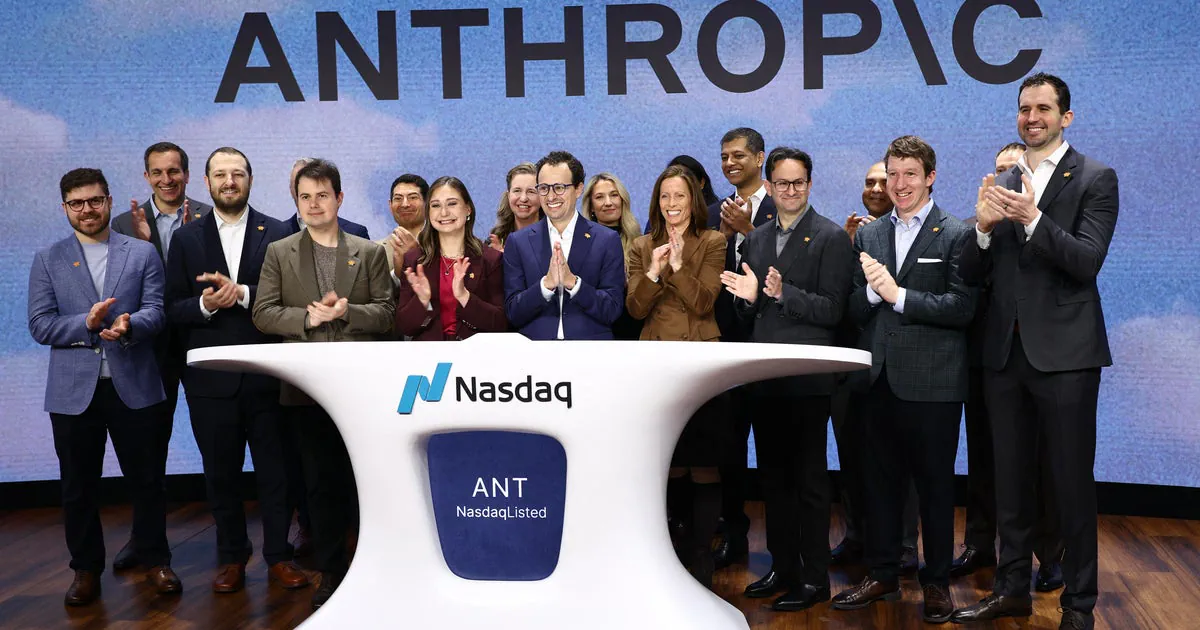
The Anthropic IPO priced at $83 per share on November 18, 2026, above the $70 to $78 range the company had marketed, and the shares began trading on the Nasdaq Global Select Market on November 19. Anthropic's pricing free writing prospectus lists 956,351,354 new shares sold by the company and 23,648,646 sold by existing stockholders, with settlement on November 20.
The deal was upsized. CNN reported that Anthropic raised the share count from 825 million to 980 million and set aside 20% of the offering for retail investors, and that the raise passed SpaceX's $75 billion listing from June as the largest ever.
Trading opened late in the morning, after Nasdaq's price-discovery auction. Dario Amodei, Anthropic's CEO, and Daniela Amodei, its president, rang the opening bell, according to Nasdaq's event listing for the ceremony at the MarketSite in Times Square.
The first day was volatile. CBS News reported that ANT opened at $111.50, up 34% from the offer, hit $114.99, then closed at $97.17 while the Nasdaq Composite fell 2.3% that afternoon.
How the offering timeline unfolded
Anthropic filed confidentially in June and published its registration statement in late October. The SEC filing index shows the steps.
| Date | Step |
|---|---|
| June 1, 2026 | Confidential draft registration statement filed |
| October 26, 2026 | Public Form S-1 filed |
| November 10, 2026 | Amended S-1 sets the $70 to $78 price range |
| November 17, 2026 | Third amendment and Nasdaq listing registration filed |
| November 18, 2026 | SEC declares the S-1 effective; IPO priced at $83 |
| November 19, 2026 | ANT begins trading on Nasdaq |
| November 20, 2026 | Settlement; private placement scheduled to close |
How much is Anthropic worth after its debut?
Anthropic was worth roughly $1.1 trillion to $1.5 trillion at the $83 offer price, depending on which shares you count. That spread explains why outlets quoted different valuations on the same day.
The narrow count uses shares actually outstanding. The prospectus says 13,219,642,276 shares of Class A and Class N stock will be outstanding after the offering and the private placement. At $83 that's about $1.10 trillion, and at the $97.17 close it's about $1.28 trillion, close to the $1.27 trillion figure cited by Yahoo Finance.
The wide count adds unvested employee awards and other promised shares. CBC News explained that its $1.51 trillion figure includes unvested options and similar commitments, which implies roughly 18.2 billion fully diluted shares. At the $114.99 intraday peak, that count produces the "more than $2 trillion" that CBS News reported.
Neither number is wrong. They answer different questions.
| Measure | Shares counted | At $83 offer | At $97.17 close |
|---|---|---|---|
| Outstanding (Class A + Class N) | ~13.22 billion | ~$1.10 trillion | ~$1.28 trillion |
| Fully diluted (CBC basis) | ~18.2 billion (implied) | ~$1.51 trillion | ~$1.77 trillion |
These are Zeniteq's calculations from the share counts in the filing and the prices reported by CBS News. The fully diluted share count is implied from CBC's figure, not stated in the prospectus summary.
How small is the public float?
The float is tiny relative to the company. The 980 million IPO shares are about 7.4% of the 13.22 billion outstanding, matching the figure CBS News attributed to Renaissance Capital, which put it at up to 9.8% including employee shares that can be sold early. A thin float tends to amplify price swings, which is one reason the first-day range ran from $111.50 to below $97.
What does the prospectus say about Anthropic's revenue and losses?
Anthropic's revenue grew about thirteenfold in a year while its operating loss shrank. The final prospectus filed November 19 reports $33.2 billion of revenue for the nine months ended September 30, 2026, against $2.5 billion in the same period of 2025.
| Line item (millions of US dollars) | FY 2024 | FY 2025 | 9M 2025 | 9M 2026 |
|---|---|---|---|---|
| Revenue | 386 | 4,585 | 2,545 | 33,242 |
| Compute and infrastructure | 2,522 | 7,326 | 4,381 | 18,808 |
| Personnel | 454 | 1,839 | 1,027 | 4,863 |
| Sales, marketing, and partnerships | 43 | 568 | 322 | 5,529 |
| Operating loss | (2,980) | (8,060) | (5,224) | (1,260) |
| Fair value change on notes, derivatives, SAFEs | (5,434) | (34,308) | (20,107) | (94,324) |
| Net loss | (8,309) | (41,965) | (25,107) | (104,039) |
Source: Anthropic's 424(b)(4) prospectus, consolidated statements of operations data.
The third quarter alone produced $17.0 billion of revenue. Anthropic says that's 1,127% more than the same quarter of 2025, while its compute and infrastructure expenses grew 382% over the same period.
Run-Rate Revenue is Anthropic's own operating metric: trailing 28-day consumption fees multiplied by 13, plus current monthly subscription fees multiplied by 12. The company says it reached about $81 billion on October 31, 2026, up $10 billion from September 30. It's a company-defined measure, not audited revenue.
Why is the net loss $104 billion if the business nearly broke even?
Most of the loss is a paper charge.
When a company has convertible notes or SAFEs outstanding, it marks them to fair value each period, and a rising company valuation makes those instruments look more expensive, which shows up as a loss.
For the first nine months of 2026, that charge was $94.3 billion, about 91% of the $104.0 billion net loss. Another $10.4 billion of other expense also sits below the operating line.
What does Anthropic's operating line show?
Anthropic's operating loss tells a different story. It fell from $5.2 billion on $2.5 billion of revenue in the first nine months of 2025 to $1.26 billion on $33.2 billion of revenue in 2026, or about 3.8% of revenue.
At the operating level, the business is close to break-even.
Two caveats apply. Compute and infrastructure still ate about 57% of revenue in 2026. And stock-based compensation reached $3.3 billion for the nine months, an expense that will grow after the listing as restricted stock units settle.
What other numbers stand out?
The prospectus adds several customer and efficiency metrics, all reported by Anthropic:
- Large customers: more than 11,900 customers paying $100,000 or more on a trailing 12-month basis, up from more than 950 a year earlier.
- Net Revenue Retention: about 900% as of September 30, 2026, meaning existing customers spent roughly nine times what they spent a year earlier.
- Revenue per employee: over $6.6 million on a trailing basis, against $1.4 million a year before.
- Cost per task: Anthropic says Opus 5.5 cut customer cost per task by about 40% compared with Opus 5.
- Legal costs: a $1.5 billion charge in 2025 for the Bartz copyright settlement.
Where does the IPO money go?
Most of it goes to compute. Anthropic expects net proceeds of about $104.8 billion from the IPO and private placement together, or $117.0 billion if underwriters buy all 147 million extra shares they hold an option on.
The prospectus lists general corporate purposes, "including investments in compute and infrastructure," plus hiring and possible acquisitions. It also earmarks $4.3 billion to cover tax withholding on restricted stock units that settle at the IPO, based on an assumed 50.90% withholding rate.
The underwriting fee was unusually thin. Underwriters took $550 million, or about 0.68% of the $81.34 billion gross, and they get nothing on the private placement or on option shares.
| Component | Amount |
|---|---|
| IPO gross proceeds | $81.34 billion |
| Of which to selling stockholders | $1.95 billion |
| Underwriting discount | $0.55 billion |
| Concurrent private placement (Class N) | $26.0 billion |
| Estimated net proceeds to Anthropic | $104.8 billion |
| With full underwriter option | $117.0 billion |
The private placement buyers are mostly Anthropic's suppliers. AMD, Broadcom, Micron, NVIDIA, and TSMC sell it chips and memory; Google and Microsoft sell it cloud capacity. Their shares aren't covered by the underwriters' lock-up, though they're restricted securities that can't be freely resold without registration.
How does Anthropic's governance work after going public?
Anthropic's founders and its Long-Term Benefit Trust control the company, and public shareholders don't. Anthropic is a public benefit corporation, a Delaware company whose directors must balance shareholder returns against the interests of people affected by its conduct and a stated public purpose: "the responsible development and maintenance of advanced AI for the long-term benefit of humanity."
The Long-Term Benefit Trust (LTBT) is a body of five financially disinterested trustees with expertise in AI safety, national security, public policy, and social enterprise. Through one share of Class T stock, it elects and removes the directors who make up a majority of the board.
The founders hold the rest of the voting power. The prospectus describes the founders' special share in plain terms, and the wording is the evidence here:
Our Class F common stock will be entitled to an aggregate number of votes that equals 50.1% of the total voting power of our outstanding shares of capital stock with respect to matters submitted to stockholders generally, including the election of our directors other than the Class T directors.
That single share is held by an LLC whose members are the seven co-founders: Dario Amodei, Daniela Amodei, Tom Brown, Jack Clark, Jared Kaplan, Sam McCandlish, and Christopher Olah.
Frequently Asked Questions
6 questions
1How much did Anthropic raise in its IPO?
Anthropic raised $81.34 billion by selling 980 million Class A shares at $83 each on November 18, 2026. Of that, about $1.95 billion went to selling stockholders. A concurrent $26.0 billion private placement with AMD, Broadcom, Google, Micron, Microsoft, NVIDIA, and TSMC brought the total to about $107.3 billion, and Anthropic expects about $104.8 billion in net proceeds.