
OpenAI is giving ChatGPT Work a more personal understanding of how people communicate. Its new writing-style feature can examine content from connected Gmail, Google Drive, Slack, and SharePoint accounts, identify recurring habits, and carry those patterns into new responses.
The feature goes beyond choosing a broad tone such as professional, friendly, or concise. OpenAI says ChatGPT Work can pick up favorite phrases, unusual capitalization, and highly specific sign-offs. In other words, it learns from the language a person has already written instead of requiring them to describe their voice in a prompt.
To try it yourself, visit this URL: https://chatgpt.com/?surface=work&writing_style=setup
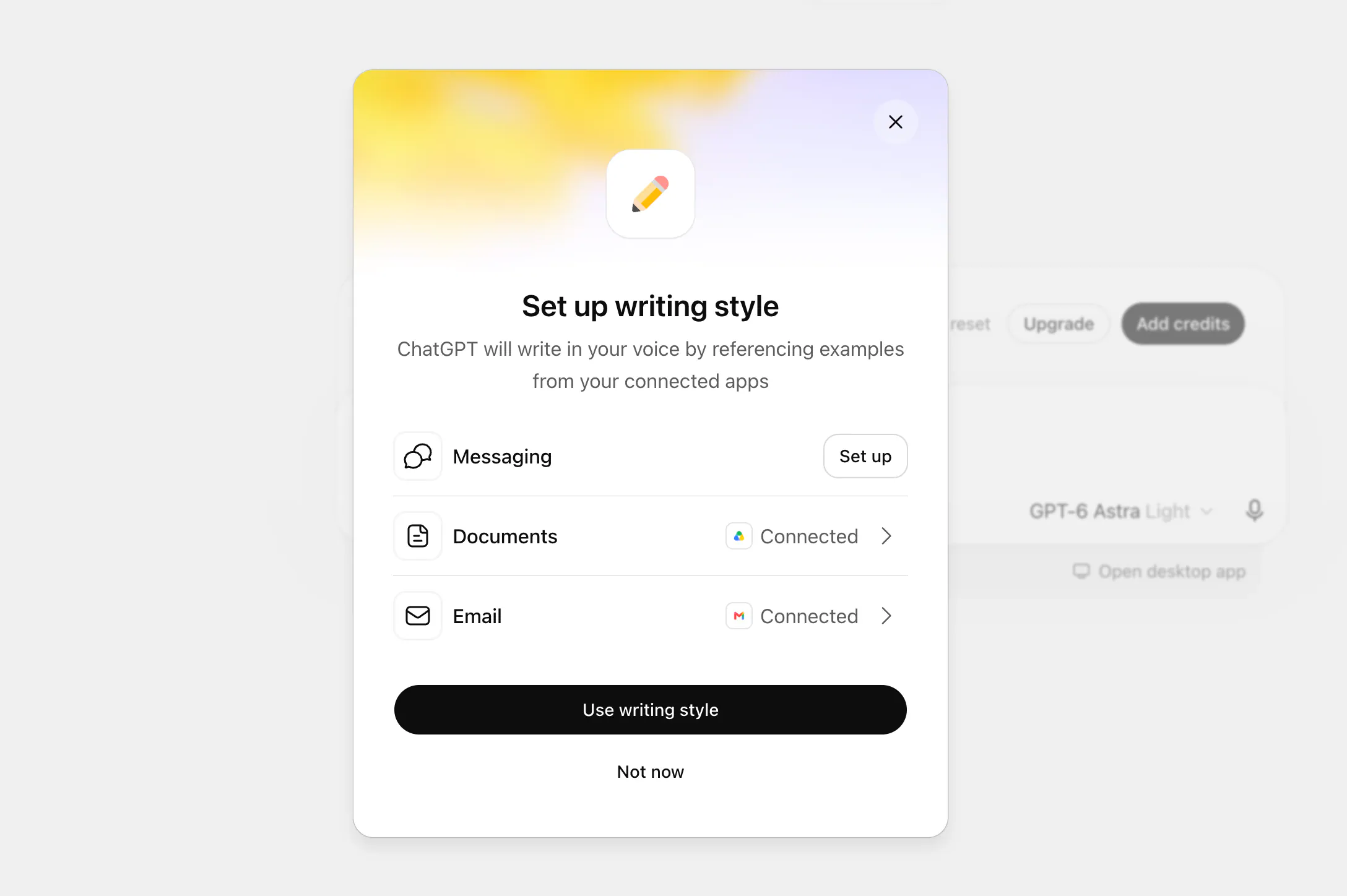
OpenAI announced the feature on September 7, 2026. Writing-style setup is available on the web for paid plans with access to ChatGPT Work. Once configured, the personalization applies to Work conversations on both web and mobile.
ChatGPT Work Now Builds a Personal Writing Profile
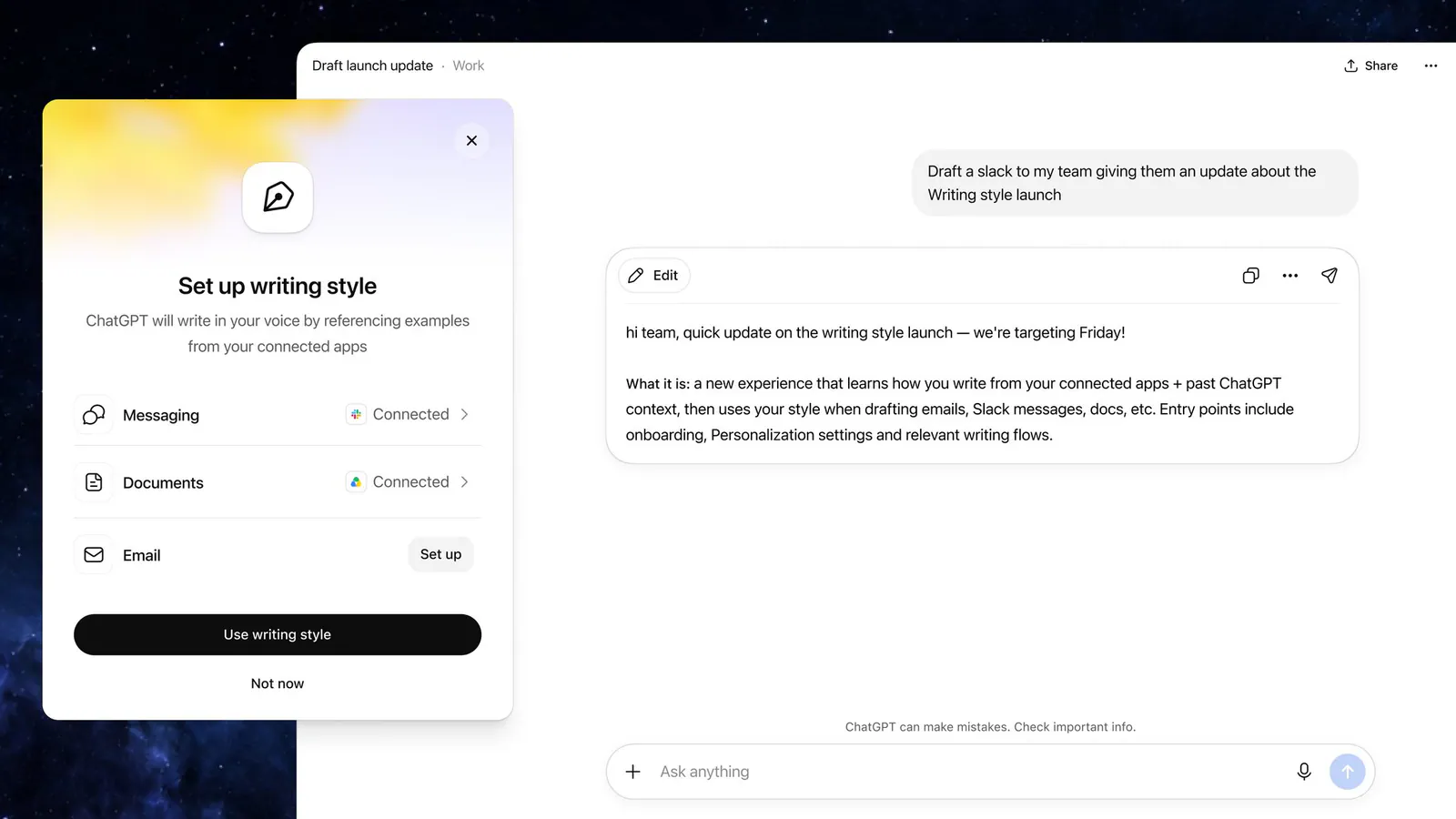
The basic idea is straightforward: connect the workplace apps containing your writing, and ChatGPT Work uses that material to infer how you tend to communicate.
That could include obvious characteristics such as whether you prefer short paragraphs or detailed explanations. It can also cover subtler patterns that are difficult to summarize in a custom prompt:
- Phrases you regularly use to introduce a point
- How you capitalize product names or internal terminology
- Whether you use contractions, fragments, or complete sentences
- The amount of context you include before making a request
- How you open and close emails
- Your preferred level of formality
Those small choices often distinguish one person’s writing from competent but generic AI text. A prompt such as “make this sound like me” provides no useful evidence unless ChatGPT already has examples of what “me” means. The new feature attempts to solve that problem by drawing on the user’s existing work.
OpenAI describes this process as learning a person’s writing style, but that should not be confused with training a new private model for each user. The announcement does not claim that ChatGPT fine-tunes a personal model, nor does it explain how the resulting style profile is represented or updated. The safer interpretation is that Work extracts writing preferences from authorized sources and uses those preferences as personalization context when generating responses.
The Useful Part Is Learning From Real Work
AI writing tools have offered tone controls for years, but tone is only one part of voice. Two people can both write professionally while sounding completely different.
One might start every update with the decision and then explain the reasoning. Another may provide context first. Some people use sentence fragments in Slack but write formal client emails. Others avoid greetings, capitalize internal project names inconsistently, or end every message with a sign-off that would never appear in a generic style preset.
Connected work apps give ChatGPT substantially better evidence than a list of adjectives. OpenAI’s Apps in ChatGPT documentation explains that authorized apps can supply relevant information from external services during a conversation. Some apps can also sync content in advance, allowing ChatGPT to retrieve it more efficiently.
For writing-style personalization, that access could make several common tasks less repetitive:
- Turning meeting notes into an update that matches the user’s normal emails
- Drafting a Slack announcement with familiar formatting and phrasing
- Rewriting a document without replacing the author’s voice with generic corporate language
- Producing follow-up messages that use the person’s customary greeting and sign-off
- Converting research into a memo that resembles their previous internal documents
The difficult part will be separating stable writing habits from context-specific behavior. A casual Slack message to a close colleague should not necessarily teach ChatGPT how to address a customer. An old document may reflect a previous role, company, or communication policy. OpenAI has not yet detailed how the feature weighs different apps, dates, audiences, or document types.
Writing Style Adds Another Layer to ChatGPT Personalization
ChatGPT already has several personalization systems, but they perform different jobs.
Custom instructions let users explicitly tell ChatGPT how to respond. A user might request short paragraphs, American English, direct recommendations, or a ban on certain words. This approach is precise, but it requires the person to identify and describe their own habits.
ChatGPT memory retains useful information and preferences across conversations. It may remember someone’s occupation, current projects, dietary requirements, or preferred programming language. Memory can influence responses, but knowing facts about a person is different from reproducing how that person writes.
The new writing-style feature introduces an inferred layer of personalization:
| Personalization Feature | What It Contributes |
|---|---|
| Writing style | Patterns inferred from the user’s existing emails, messages, and files |
| Custom instructions | Rules and preferences the user states directly |
| Memory | Relevant details ChatGPT retains across conversations |
These systems could complement each other. A style profile may capture the user’s natural rhythm, while custom instructions impose requirements that do not appear consistently in past writing.
Conflicts are also possible. Someone might instruct ChatGPT to write more concisely even though their existing documents are long and heavily qualified. OpenAI’s announcement does not explain how Work resolves disagreements among writing style, memory, explicit instructions, and the request in the current prompt. In practice, the most recent and specific instruction should be treated as the user’s intent, but the feature’s actual priority rules have not been published.
Connected Writing Creates a Privacy Tradeoff
The feature becomes useful by examining personal and workplace communication, which also makes data governance central to the experience.
Email, Slack, cloud storage, and SharePoint can contain customer information, employment discussions, financial records, legal documents, product plans, and conversations that were never written with AI analysis in mind. A user may be comfortable connecting published documents but not an entire mailbox. Organizations may also have rules limiting which services employees can connect to external tools.
OpenAI says ChatGPT apps respect the permissions already associated with the connected account. A person should not gain access to files simply because an app has been connected. For synced sources, such as the Google Drive app with sync, the available content is still governed by the user’s existing permissions.
Model-training policies depend on the type of ChatGPT account. OpenAI’s apps documentation says information accessed through connected apps may be used to improve models for consumer services when the “Improve the model for everyone” control is enabled. OpenAI states in its enterprise privacy commitments that data from ChatGPT Business, Enterprise, Edu, and its API platform is not used to train models by default.
Before enabling writing-style analysis, users should check:
- Which accounts and workspaces they are connecting
- Whether the selected sources contain sensitive or regulated information
- Which apps their organization’s administrator permits
- Whether model improvement is enabled in ChatGPT Data Controls
- Whether older files and messages accurately represent their current voice
- Whether company policies permit AI tools to analyze internal communication
OpenAI also needs to make the boundaries of the style profile understandable. Users should be able to tell which sources influenced it, update it when their role changes, and remove patterns they do not want ChatGPT to repeat. A generated profile that cannot be inspected or corrected would turn personalization into guesswork.
AI Can Sound Like You and Still Be Wrong
Matching someone’s voice does not make a draft accurate, appropriate, or ready to send.
In fact, familiar writing can create a new review problem. A document that sounds convincingly like its author may feel more trustworthy than conventional AI output, even when it contains an incorrect date, an unsupported claim, or a commitment the author would never make.
Writing-style personalization can also preserve habits that the user would prefer to change. It may reproduce unnecessary qualifiers, inconsistent capitalization, outdated terminology, or a sign-off that belongs only in certain conversations. An AI system optimized to imitate existing work is not automatically optimized to improve it.
The feature is therefore best suited to reducing editing time, not eliminating review. Users should still verify factual statements, names, numbers, recipients, attachments, and commitments. High-stakes material involving legal, financial, medical, personnel, or public communications needs the same scrutiny regardless of how authentic the prose sounds.
Context will be the decisive test. If ChatGPT Work can distinguish a board memo from a Slack reply while retaining the person’s recognizable voice, the feature could save substantial rewriting. If it blends every connected source into one averaged style, its output may sound less like a person and more like a collage of their past messages.
How to Set Up ChatGPT Work Writing Style
Users can open the writing-style setup page while signed in to ChatGPT on the web. The same option is available through Settings → Personalization → Writing style.
From there, connect the supported work apps that contain useful examples of your writing. Access to individual apps can depend on the ChatGPT plan, geographic region, workspace configuration, and administrator settings.
OpenAI says setup is currently available on the web for all paid plans with ChatGPT Work access. After it is enabled, the writing style applies to messages across ChatGPT Work on both web and mobile.
A sensible first test is to give Work a familiar assignment, such as drafting a project update or rewriting an email. Compare the result with a recent message you actually sent. Look beyond vocabulary and check whether it reproduces the right level of detail, structure, formality, capitalization, and closing. The goal is not perfect imitation. It is a useful first draft that requires fewer instructions and fewer edits.
Final Thoughts
The important development is not that ChatGPT can copy a favorite sign-off. It is that OpenAI is replacing abstract tone prompts with evidence from the way people already communicate.
That approach could make AI writing noticeably less generic, but only if ChatGPT Work preserves context and gives users meaningful control over the sources and patterns it uses. A writing profile that understands the difference between a quick Slack reply and a customer email would be genuinely practical. One that simply repeats recognizable quirks everywhere would amount to a more personalized form of autocomplete.
Frequently Asked Questions
5 questions
1What is ChatGPT Work writing style?
ChatGPT Work writing style is an AI personalization feature that learns recurring language patterns from connected emails, messages, and files. It can identify habits such as favorite phrases, sentence structure, capitalization, formality, and sign-offs, then apply those patterns when generating new content inside ChatGPT Work.
2
Sources
- ChatGPT Workopenai.com
- https://chatgpt.com/?surface=work&writing_style=setupchatgpt.com
- https://x.com/ChatGPT/status/2097018264048251309x.com
- Apps in ChatGPT documentationhelp.openai.com
- Custom instructionshelp.openai.com
- ChatGPT memoryhelp.openai.com
- Google Drive app with synchelp.openai.com
- enterprise privacy commitments


